

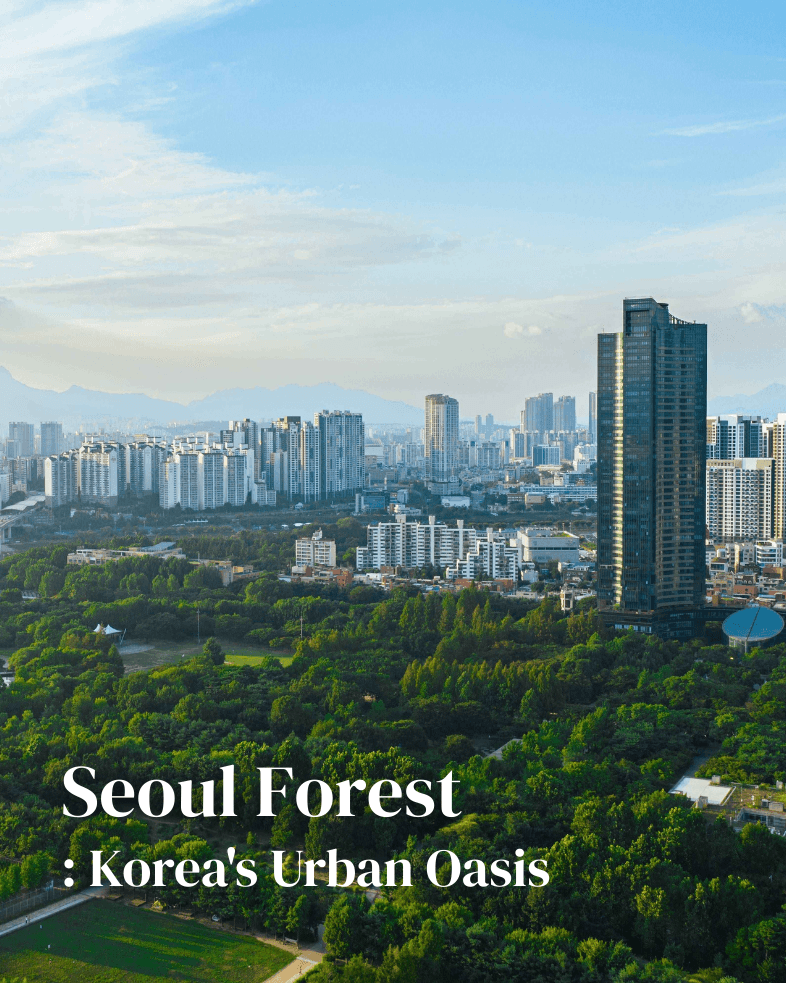

Location: Seongdong-gu, Seoul | Category: Urban Park | Best For: Nature lovers, Families, Photographers
A 595,000-square-meter park sits between the Han River and Jungnangcheon Stream, right in the middle of Seoul's trendiest district. Seoul Forest opened in June 2005 after a ₩235.2 billion transformation from what was once a horse racing track, a golf course, and the city's first water treatment plant. Today, it draws locals and visitors looking for green space without leaving the city.
This guide breaks down the four themed zones, seasonal highlights, and practical details for planning your visit.

At a Glance
| Address | 273 Ttukseom-ro, Seongdong-gu, Seoul (서울 성동구 뚝섬로 273) |
| Hours | Main park 24/7; Eco Forest 05:30-21:30; Insect Garden 10:00-17:00 (closed Mondays) |
| Admission | Free |
| Time Needed | 1.5-3 hours |
| Best Time | Spring (cherry blossoms), Autumn (ginkgo trees), Weekday mornings |
Why This Park Draws Crowds
Seoul Forest is the third largest park in the capital, covering more ground than 80 football fields. The Seoul Metropolitan Government built it through a public-private partnership—over 5,000 citizens and 70 companies contributed to planting the initial trees between 2003 and 2005.
The park now contains more than 420,000 trees and roughly 100 animal species. That includes a deer enclosure, butterfly garden, and insect exhibition that make it a popular destination for families. For adults, the draw is simpler: a rare chance to walk under tree canopies without leaving the subway network.
What keeps people coming back is the seasonal variety. Cherry blossoms line the Eco Forest paths in April. Tulips fill the flower beds in spring. The Metasequoia Road turns golden in autumn, and the Ginkgo Tree Forest becomes one of the city's most photographed spots from late October through November.
What to See: Four Themed Zones
Culture & Art Park
The main entrance opens into the largest zone. Horse statues mark the spot—a nod to the area's racing track history from 1954. Beyond them, open lawns spread out under old-growth trees.

Key spots in this zone:
Family Lawn — The largest open grass area, popular for picnics and casual sports. Weekends get crowded by noon, so arrive before 10:00 AM for space.
Ground Fountain — Operates May through September. Sessions run at 1:00 PM, 2:00 PM, 3:00 PM, and 4:00 PM (30 minutes each). July and August add a noon session.
Outdoor Stage — Hosts occasional performances and seasonal events. Check the park's official site for schedules.
Eco Forest
Cross the footbridge from the main area to reach the ecological zone. This is where most of the signature photo spots are located.


Metasequoia Road — Two rows of tall Dawn Redwood trees create a tunnel effect. Best light: early morning or late afternoon. Avoid weekends between 11:00 AM and 3:00 PM if you want photos without crowds.
Deer Corral — Home to several Sika deer. Before 2020, visitors could feed them directly. The current setup keeps a fence between visitors and animals, but they're still easy to observe. The deer are most active in the morning.
Butterfly Garden — Open May through October, 10:00 AM to 5:00 PM (closed Mondays). A small greenhouse with live butterflies—brief but worthwhile if you're visiting with children.
Insect Garden — Same hours as the Butterfly Garden. Features beetle exhibits and seasonal insect displays. Closed November through April (winter season hours: 11:00 AM to 4:00 PM, entry until 3:30 PM).
Wetland Ecology Center
The park's northeastern section preserves the marshland ecosystem that once covered this area.

Wetland Pond — Reeds, silver banner grass, and water chestnuts grow along the banks. Migratory birds stop here in spring and fall. Early morning visits offer the best chance to spot wildlife.
Observation Decks — Several wooden platforms allow views over the marsh without disturbing the habitat.
Hangang Riverside Connection
The park connects directly to Hangang Waterside Park via an overhead footbridge (Gate 11). Cyclists and walkers use this route to extend their trip along the river.
Seasonal Guide
| Season | Highlights | What to Expect |
| Spring (Mar-May) | Cherry blossoms, tulips, forsythia | Peak crowds mid-April; book picnic spots early on weekends |
| Summer (Jun-Aug) | Green canopy, fountain, water play | Hot and humid; come before 10 AM or after 5 PM |
| Autumn (Sep-Nov) | Ginkgo forest, Metasequoia colors | Best foliage late October; heavy foot traffic on weekends |
| Winter (Dec-Feb) | Bare trees, quiet paths | Some facilities closed; good for solitary walks |
Getting There
By Subway (Recommended)
- Suin-Bundang Line → Seoul Forest Station, Exit 3 → 5-minute walk to Gate 2
- Line 2 → Ttukseom Station, Exit 8 → 10-minute walk to Gate 5
The Bundang Line option drops you closer and passes through Under Stand Avenue, a container-box shopping street worth a quick look.
By Taxi
Tell the driver: "Seoulssup gongwon" (서울숲공원) or show: 서울 성동구 뚝섬로 273
From Gangnam or Myeongdong, expect ₩8,000-15,000 depending on traffic (approximately $6-11 USD).
By Bicycle
Seoul Bike (Ddareungi) stations sit at the main entrance. Download the app, unlock a bike for ₩1,000/hour, and cycle into the park or along the Han River path.
Private rentals are available near Gate 5: ₩4,000/hour or ₩10,000/full day. Photo ID required.
Practical Tips
Timing Your Visit Weekday mornings (before 11:00 AM) offer the emptiest paths. Weekend afternoons—especially in spring and autumn—bring significant crowds to the Metasequoia Road and Deer Corral areas. Tuesday through Thursday are consistently quieter.
What to Bring Picnic mat (grass is often damp), water, sunscreen in summer. The park has two convenience stores—one near the visitor center at the main entrance—but limited food options deeper inside.
Rentals at the Park Wheelchairs and strollers: free at the Information Desk (ID required, 2-hour limit) Bicycles: near Gate 5 or via Seoul Bike app
Nearby Food & Coffee Seoul Forest Cafe Street runs along Gates 4 and 5. Independent cafes and restaurants fill converted warehouses and low-rise buildings—part of the Seongsu-dong neighborhood that's become Seoul's answer to Brooklyn.
Accessibility Main paths are paved and flat. Some gravel sections exist in the Eco Forest area—wheelchair users should stick to the main routes. Electric wheelchair charging stations are available at the Information Desk.

Is It Worth the Trip?
Go if: You want green space without leaving the city, you're traveling with kids who need to run around, or you're visiting Seoul in spring or autumn and want to see seasonal colors without fighting Yeouido or Seokchon Lake crowds.
Skip if: You're looking for dramatic mountain scenery (head to Bukhansan instead) or you only have one day in Seoul and haven't seen the palaces yet.
For a free attraction that's accessible by subway and changes character with each season, Seoul Forest delivers. Budget 2 hours minimum—more if you're combining it with the Seongsu-dong cafe scene or a Han River walk.
📌 Quick Reference
- Official site: seoulforest.or.kr/english
- Real-time updates: Visit Seoul - Seoul Forest
- Info hotline: ☎ 02-460-2905 (Korean; weekdays)
- Parking info: ☎ 02-461-2916
- Location: 273 Ttukseom-ro, Seongdong-gu, Seoul (서울 성동구 뚝섬로 273)