


Type: Korean Culture | Theme: Traditional Holiday | For: Travelers in Korea during Feb 16-18, 2026
Korea empties out during Seollal. Millions head to hometowns, leaving Seoul quieter than any other week of the year. For travelers, this creates a strange opportunity: major attractions with minimal crowds, free palace admission, and front-row access to traditions that most tourists never witness. The catch? Knowing what's open, what's closed, and where to actually go.

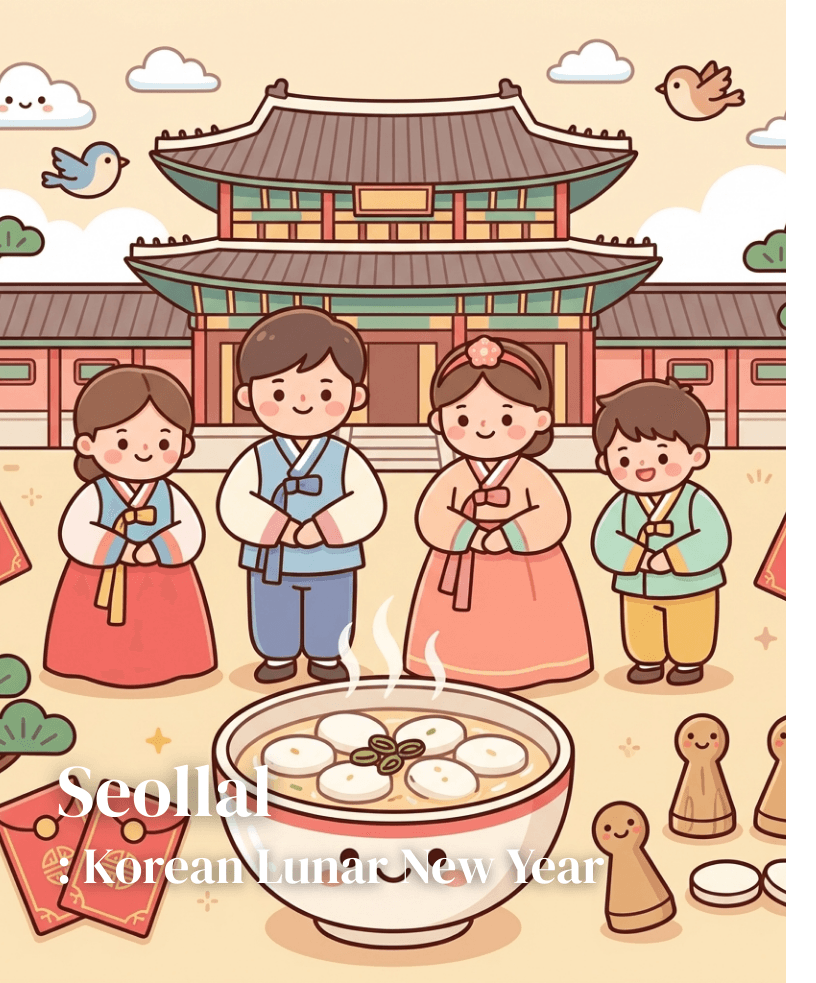
Tteokguk, hanbok, lucky envelopes, and traditional games—the essentials of Korean Lunar New Year.
Quick Guide at a Glance
| Holiday Dates | February 16-18, 2026 (Mon-Wed) |
| Lunar New Year Day | February 17, 2026 |
| Best For | Culture-curious travelers, photographers, K-drama fans |
| Key Locations | Gyeongbokgung, Namsangol Hanok Village |
| What's Open | Palaces (free), major attractions, hotel restaurants |
| What's Closed | Small restaurants, local shops, markets (partial) |
What is Seollal?
Seollal (설날) ranks as Korea's most significant traditional holiday—equivalent to Thanksgiving and Christmas combined. Families gather for ancestral rites, share elaborate meals, and pass down customs that date back centuries. The holiday officially spans three days: the day before, the day of, and the day after the lunar new year.
Here's the thing about Seollal as a traveler: you won't crash a family gathering. Koreans celebrate privately at home. But cultural sites across Seoul run special programs specifically designed to share these traditions with visitors. Think of it as Korea opening its living room door—just a crack.
Tteokguk (떡국) — The Birthday Soup
Every Korean eats tteokguk on Seollal morning. The rice cake soup carries more weight than typical comfort food: finishing a bowl symbolically adds one year to your age. Skip breakfast, skip birthdays—at least according to tradition.

Sliced rice cakes float in clear beef broth, topped with egg ribbons, seaweed, and seasoned beef. The oval shapes represent coins and prosperity.
The soup itself tastes clean and savory. Chewy rice cake slices (tteok) sit in anchovy or beef broth, garnished with egg strips, green onion, and dried seaweed. Regional variations exist—some families add dumplings (manduguk), others prefer soy sauce broth.
Where to try it: Hotel buffets often include tteokguk during Seollal week. In tourist areas, Korean restaurants serving "hanjeongsik" (full-course meals) typically keep Seollal menus running. Gwangjang Market stays partially open and serves various rice cake dishes year-round.
Cost: ₩8,000-15,000 (~$6-11) at restaurants
Sebae (세배) — The Deep Bow
Watch any Korean family on Seollal morning and you'll witness sebae: children and younger relatives performing a formal deep bow to elders. Hands placed together, forehead nearly touching the floor. It looks simple. The gesture carries generations of respect.

After sebae, elders gift sebaetdon (세뱃돈)—lucky money in decorative envelopes. The red and gold packaging echoes the colors of fortune.
Elders respond with New Year blessings and sebaetdon—crisp bills tucked into decorated envelopes. Kids accumulate small fortunes over the holiday visiting grandparents, aunts, and uncles. Adults give; children receive. The exchange reinforces family hierarchy in the most tangible way possible.
What travelers see: Cultural centers like Namsangol Hanok Village often stage sebae demonstrations. Staff in hanbok guide visitors through the proper form. It's participatory—you can bow, receive fake lucky money, hear the traditional New Year greeting: "새해 복 많이 받으세요" (Saehae bok mani badeuseyo, "May you receive many blessings in the new year").
Hanbok (한복) — Dress the Part
Seollal remains one of the few occasions when everyday Koreans still wear hanbok, traditional Korean clothing. The flowing silhouettes—high-waisted skirts for women, loose trousers and jackets for men—transform palace grounds into something resembling a period drama set.

Renting hanbok takes about 20 minutes. Shops near palaces handle thousands of tourists; staff move quickly through sizing and dressing.
Renting hanbok yourself unlocks a practical benefit: free admission to all major palaces during Seollal (and year-round, actually). Gyeongbokgung, Changdeokgung, Deoksugung—walk past the ticket line in traditional dress.
Rental shops: Dozens cluster around Gyeongbokgung's east gate (Anguk Station area). Expect ₩15,000-30,000 (~$11-22) for 2-4 hours. Winter hanbok includes padded layers. Book nothing in advance; walk-ins work fine.
Photo tip: Morning light hits Gyeongbokgung's main courtyard best. Arrive when gates open (9 AM) to beat tour groups. The throne hall reflection pool creates the shot everyone wants.
Traditional Games
Korean holiday gatherings inevitably involve yutnori (윷놀이), a board game that predates most Western equivalents. Four wooden sticks get tossed; how they land determines movement across a cloth board. Rules take five minutes to learn. The shouting matches that follow can last hours.

Three generations around a game board—this scene repeats in households across Korea during Seollal. Yutnori works with any number of players.
Teams form naturally: kids versus adults, siblings versus in-laws. The game requires no skill, just luck and volume. When your sticks land favorably, you yell. When opponents advance, you groan. The dynamics need no translation.

Yeon-nal-li-gi (연날리기): Traditional Korean kites feature geometric patterns in primary colors. The diamond shape with a center hole catches winter wind efficiently.
Outdoors, kite flying (yeon-nal-li-gi) fills parks and riverbanks. Traditional Korean kites look distinct—rectangular frames with circular holes in the center. The design dates back centuries, optimized for Korea's winter winds. Hangang parks along the river become informal kite grounds during the holiday.
Where to play: Namsangol Hanok Village sets up yutnori stations during Seollal programs. Staff explain rules in English. Jegichagi (Korean shuttlecock kicking) stations usually appear nearby. Think hacky sack, but with a small weighted shuttlecock.
Where to Go: Namsangol Hanok Village (남산골한옥마을)
Namsangol sits at Namsan's base, a five-minute walk from Chungmuro Station. Five restored hanok buildings from the Joseon Dynasty surround a central courtyard—essentially an open-air museum of traditional architecture that transforms into Seollal headquarters every February.

The village reconstructs Joseon-era Seoul. During Seollal, every courtyard hosts activities: calligraphy, crafts, games, and performances.
Seollal programs run February 16-18, 2026 (dates TBC closer to the event). Previous years included:
- Traditional folk performances (samulnori drumming, fan dances)
- Sebae ceremonies with photo opportunities
- Yutnori and jegichagi game stations
- Craft workshops (hanji paper, lucky pouches)
- Tteokguk tastings (limited quantities)
Practical details:
| Address | 28 Toegye-ro 34-gil, Jung-gu, Seoul |
| Hours | 09:00-21:00 (Seollal programs 10:00-17:00) |
| Admission | Free |
| Getting There | Chungmuro Station (Lines 3, 4), Exit 4 |
| Time Needed | 1.5-2 hours |
The reality check: Programs draw crowds, especially midday. Arrive at opening (10 AM) or late afternoon (after 3 PM) for breathing room. The grounds stay open after programs end—quieter evening walks reveal the village without the activity chaos.
Where to Go: Gyeongbokgung Palace (경복궁)
Gyeongbokgung needs no Seollal justification—it's Korea's grandest palace regardless of season. But the holiday adds layers: free admission for everyone, thinner crowds than typical weekends, and a higher concentration of hanbok-wearing visitors creating that time-slip atmosphere.

Royal court ceremonies still occur at Gyeongbokgung. Traditional musicians in crimson robes perform pieces unchanged for centuries.
The palace complex spans 40 hectares. Most visitors stick to the central axis: Gwanghwamun Gate → Geunjeongjeon (throne hall) → rear gardens. Allow 90 minutes minimum; history enthusiasts spend half a day.
Seollal specifics:
- Admission: Free (normally ₩3,000)
- Royal guard ceremony: 10:00, 14:00 at Gwanghwamun (check schedule—may be suspended during holidays)
- Hanbok rental: Wear one for free entry year-round, but Seollal brings more dressed-up visitors for better photos
Practical details:
| Address | 161 Sajik-ro, Jongno-gu, Seoul |
| Hours | 09:00-18:00 (last entry 17:00) |
| Closed | Tuesdays (but open if Tuesday falls during Seollal) |
| Getting There | Gyeongbokgung Station (Line 3), Exit 5 |
| Time Needed | 1.5-3 hours |
Photo spots: The throne hall courtyard offers symmetry shots. Hyangwonjeong Pavilion (hexagonal structure over a pond) in the rear garden photographs best in afternoon light.
Practical Tips for Seollal Travelers
Plan transportation early. Koreans travel home the week before Seollal—train tickets sell out fast. KTX reservations open 1 month ahead; foreigners access remaining seats after locals. Book inter-city travel before February if heading outside Seoul.
Expect closures. Small restaurants, family-run shops, and local businesses shut down. Chains (cafes, convenience stores, fast food) stay open. Hotel restaurants operate normally. Markets like Gwangjang remain partially open, but vendor attendance drops.
Museums close on the actual holiday. National Museum of Korea, war memorials, and most cultural institutions close February 17 (Seollal day itself). Palaces stay open with free admission.
Cash still matters. ATMs work, but some smaller vendors accept cash only. International card acceptance varies outside major tourist areas.
Layer appropriately. February in Seoul averages -3°C to 4°C (27°F to 39°F). Palace visits involve outdoor walking. Hanbok rentals include winter padding, but your own thermal layers help.
Learn one phrase. "새해 복 많이 받으세요" (sae-hae bok ma-ni ba-deu-se-yo) means "May you receive many blessings in the new year." Koreans appreciate the effort, even with imperfect pronunciation.
FAQ
Q: Is Seoul empty during Seollal? A: Quieter than normal, yes. Locals leave the city to visit family in hometowns. Tourist areas still function—attractions stay open, restaurants in Myeongdong and Hongdae operate. Public transport runs on holiday schedules (less frequent).
Q: Can I experience Seollal traditions as a tourist? A: Absolutely. Cultural sites like Namsangol Hanok Village run programs specifically for this. You won't attend private family gatherings, but public events let you try food, games, and ceremonies firsthand.
Q: What if I'm vegetarian/vegan? A: Traditional Seollal food centers on meat-based broth and dishes. Hotel buffets offer more variety. Buddhist temple cuisine restaurants serve plant-based Korean food year-round—search "사찰음식" (sachal eumsik) for options.
Closing
Seollal compresses centuries of Korean tradition into three days. Travelers who happen to visit during the holiday—whether by accident or intention—get access to cultural programming that doesn't exist the other 362 days of the year. The palaces feel more authentic. The hanbok crowds multiply. The rice cake soup tastes the same, but eating it on the actual day means something different.
February 16-18, 2026. Mark the dates.
새해 복 많이 받으세요.
📌 Quick Reference Card
| Item | Details |
| Holiday | Seollal (설날) — Korean Lunar New Year |
| 2026 Dates | February 16-18 (Lunar New Year Day: Feb 17) |
| Key Locations | Gyeongbokgung Palace, Namsangol Hanok Village |
| Free Entry | All major palaces during Seollal |
| Must-Try Food | Tteokguk (rice cake soup) |
| Best For | Cultural immersion, photography, fewer crowds |
| Useful Links | [Visit Korea](https://english.visitkorea.or.kr), [Seoul Tourism](https://english.visitseoul.net) |