

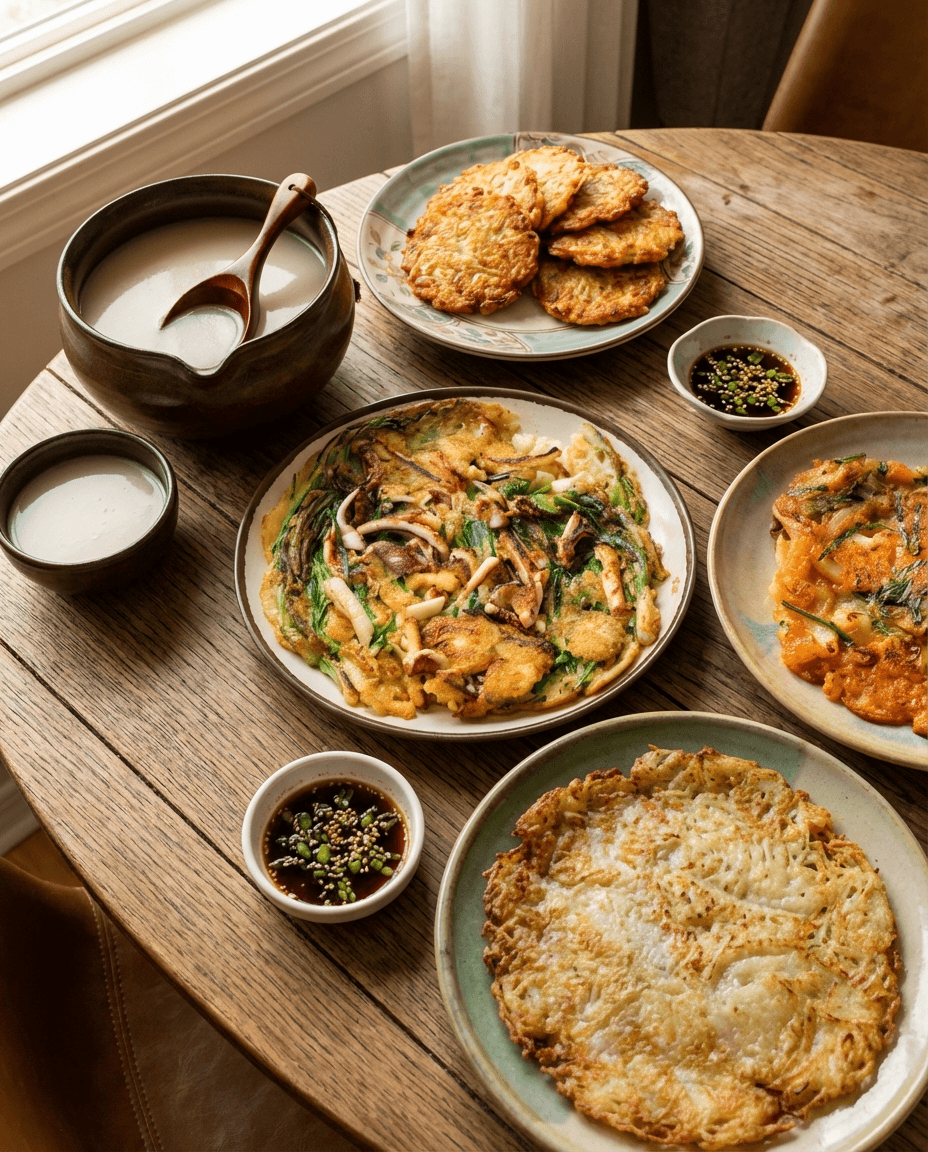

Type: Traditional Drink + Savory Pancakes | Price Range: ₩15,000-30,000 per person | Best For: Rainy days, Groups, Traditional food lovers
Rain taps against the window. A milky bowl of rice wine appears alongside a sizzling golden pancake. This ritual repeats across Korea whenever clouds roll in—makgeolli and jeon belong together like few other food pairings in the world.
The combination dates back centuries, but it remains one of the easiest ways to eat and drink like a local. Here's what to order, where to find it, and why Koreans insist on this pairing when the weather turns gray.

At a Glance
| Food Type | Rice Wine + Savory Pancakes |
| Price Range | ₩15,000-30,000 (~$11-22) per person |
| Alcohol Content | 6-8% ABV |
| Best Areas | Jongno, Insadong, Gwangjang Market |
| Best Time | Rainy afternoons, Evening |
| Dietary Note | Gluten in most jeon; vegetarian options available |
What Is Makgeolli?

Korea's oldest alcoholic drink. Makgeolli (막걸리) is an unfiltered rice wine with a cloudy, milky appearance and slightly fizzy texture. The taste lands somewhere between sweet and tangy, with a creamy finish that coats the tongue.
At 6-8% alcohol, it's lighter than wine but more complex than beer. The fermentation process creates natural probiotics and a subtle effervescence. Traditional versions use only rice, water, and nuruk (a fermentation starter), though modern varieties add wheat or sweeteners.
Two main types exist:
- Saengmakgeolli (생막걸리): Unpasteurized, still fermenting, shorter shelf life. Fuller flavor, more carbonation.
- Salmakgeolli (살막걸리): Pasteurized for longer storage. Smoother but less complex.
Shake the bottle before pouring—the rice sediment settles at the bottom. Drink from a brass or ceramic bowl for the traditional approach.
What Is Jeon?
Jeon (전) refers to Korean savory pancakes—ingredients dipped in egg batter and pan-fried until golden. The category spans dozens of varieties, from simple vegetable versions to elaborate seafood platters.
The name changes based on what goes inside: pajeon (green onion), kimchijeon (kimchi), haemul-pajeon (seafood with green onion). Each version delivers a different texture and flavor profile, but all share that crispy-edged, slightly chewy character.
Jeon appears at holiday tables, drinking sessions, and rainy day meals. The sizzling sound of batter hitting a hot pan supposedly mimics rainfall—one theory for why Koreans crave jeon when it rains.
The Classic Jeon Varieties
Haemul Pajeon (해물파전)

Price: ₩15,000-20,000 | Size: Large, shareable | Spice Level: None
The showstopper. Long green onions form the base, topped with squid, shrimp, clams, and sometimes octopus. A proper haemul pajeon arrives large enough for 2-3 people to share, edges lacy and crisp while the center stays soft with pockets of egg.
The seafood adds briny depth that cuts through makgeolli's sweetness. Dip each piece in a soy-vinegar sauce with sliced chili. Best consumed hot—the texture changes as it cools.
Kimchijeon (김치전)

Price: ₩8,000-12,000 | Size: Medium | Spice Level: Medium
Fermented kimchi transforms when pan-fried. The sourness mellows, the edges caramelize, and each bite delivers a tangy punch. Well-aged kimchi (mugeunji, 묵은지) makes the best version—deeper flavor, more funk.
The reddish-orange color comes from kimchi's gochugaru. Look for uneven edges and visible kimchi pieces rather than a uniform disc. Pairs exceptionally well with makgeolli's creamy body.
Gamjajeon (감자전)

Price: ₩7,000-10,000 | Size: Medium | Spice Level: None
Grated potato, pan-fried until golden. The texture sits between crispy and chewy—starchier than Western hash browns, with a slight stickiness inside. Some versions add whole potato slices for varied texture.
A mild, slightly sweet option that works as a palate cleanser between spicier dishes. The subtle flavor lets makgeolli's complexity shine.
Nokdujeon / Bindaetteok (녹두전/빈대떡)

Price: ₩8,000-12,000 | Size: Medium | Spice Level: None
Ground mung beans create a distinctly nutty, hearty pancake. The batter often includes pork, kimchi, and fernbrake (gosari). Thicker than other jeon, with a slightly crumbly texture.
Gwangjang Market claims this dish as its signature. The market version comes fresh off massive griddles, glistening with oil. A Jongno-area specialty worth seeking out.
Why This Pairing Works
The science is simple. Makgeolli's mild acidity and effervescence cut through jeon's oiliness. The rice wine's sweetness balances savory, salty, and spicy elements. Each sip resets the palate for the next bite.
Koreans describe this as "gunghap" (궁합)—flavors that naturally complement each other. The textural contrast matters too: creamy liquid against crispy-chewy solid.
The rainy day connection: Multiple theories exist. Some say the sizzling sound of jeon cooking sounds like rain. Others point to lower atmospheric pressure affecting taste perception. Practical explanations suggest farmers historically had time to cook and drink during rain. Whatever the reason, the association runs deep in Korean food culture.
Where to Order
Traditional Markets:
- Gwangjang Market (광장시장): Multiple stalls serve bindaetteok with makgeolli. Expect to stand or perch on tiny stools. Cash preferred. Most active 10 AM - 9 PM.
- Tongin Market (통인시장): Known for its coin lunch box system, but several vendors sell jeon.
Jongno Area: The neighborhood between Jongno 3-ga and Euljiro stations holds dozens of "makgeolli golmok" (makgeolli alley) spots. These cramped, decades-old establishments serve house-made or locally sourced rice wine with jeon platters.
What to expect: Basic interiors, plastic tables, older clientele during daytime, younger crowds at night. Most places run ₩15,000-25,000 per person for makgeolli and 2-3 jeon varieties.
Upscale Options: Modern makgeolli bars in Gangnam and Itaewon serve premium craft versions (₩12,000-20,000 per bottle) with refined jeon presentations. Different vibe, higher prices, Instagram-ready plating.
How to Order
Basic Korean phrases:
- "Makgeolli hana juseyo" (막걸리 하나 주세요) — One makgeolli, please
- "Pajeon juseyo" (파전 주세요) — Pajeon, please
- "Mwo ga masisseoyo?" (뭐가 맛있어요?) — What's good here?
Order strategy:
- Start with one bottle of makgeolli (serves 2-3 people)
- Order one large jeon (haemul pajeon) plus one smaller variety
- Add more as needed—portions are shareable
The dipping sauce: Most places provide a soy-vinegar sauce automatically. Some add gochugaru (red pepper flakes) or green onion. Mix to your preference.
Pace yourself: Makgeolli's low alcohol content deceives. The sweetness masks strength. Traditional drinking etiquette: pour for others, receive with two hands, turn slightly away when drinking with elders.
Practical Tips
Timing matters. Jeon tastes best within 10 minutes of cooking. Reheated or sitting versions lose their crisp edges. Busy restaurants with high turnover serve fresher batches.
Check the makgeolli source. Ask if it's saengmakgeolli (unpasteurized) for the freshest taste. Bottles with visible sediment and upcoming expiration dates indicate less processing.
Rainy day crowds. Koreans genuinely flock to jeon restaurants when it rains. Popular spots fill quickly on wet afternoons and evenings. Weekday rain offers easier seating than weekend downpours.
Vegetarian options. Gamjajeon (potato), hobakjeon (zucchini), and buchu-jeon (chive) contain no meat. Confirm no seafood or pork in the batter—some restaurants add anchovy paste or pork fat.
Gluten concerns. Most jeon batters use wheat flour. Rice-flour versions exist but require asking specifically. Makgeolli traditionally contains only rice, but some brands add wheat.
Leftovers don't travel well. Jeon loses its texture quickly. Finish what you order rather than packing it up.
Quick Reference
- Best areas: Jongno, Gwangjang Market, Insadong
- Average price: ₩15,000-25,000 per person
- Reservation: Not needed for most traditional spots
- Dietary info: Gluten in most jeon; vegetarian options available; makgeolli contains alcohol
- Related dishes: Buchimgae (부침개), jijim (지짐), bindaetteok (빈대떡)
- Best consumed: Rainy days, cool evenings, with 2+ people