

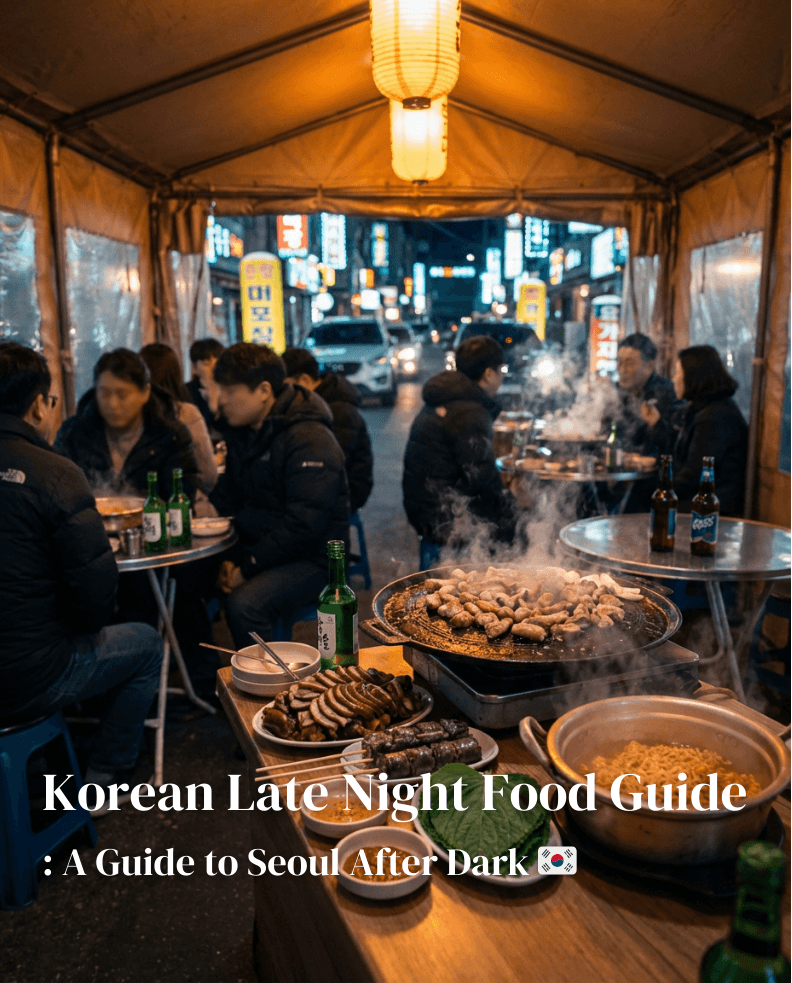

Type: Late-Night Food / Drinking Food | Price Range: ₩8,000-35,000 (~$6-25) | Best For: Night owls, soju lovers, groups

Braised pig's trotters sliced thin enough to see through. Intestines sizzling on a grill until they pop with fat. Instant noodles in a dented gold pot at 2 AM. Late-night eating in Korea isn't a backup plan — it's the main event. Most restaurants keep their kitchens running well past midnight, and some of Seoul's best food only shows up after dark.
This guide covers the five essential late-night dishes, where to find them, and how to order without pointing randomly at the menu.
At a Glance
| Food Type | Late-Night / Drinking Food (야식) |
| Price Range | ₩8,000-35,000 (~$6-25) |
| Spice Level | Mild to Medium (most dishes) |
| Best Areas | Jongno 3-ga, Euljiro, Hongdae, Sinchon |
| Best Time | 9 PM - 3 AM (peak at 11 PM - 1 AM) |
| Drinks | Soju, beer, makgeolli |
What Is Korean Late-Night Food?
Koreans have a word for it: yasik (야식). It translates to "night food," but the cultural weight goes deeper than a late dinner. Yasik is what happens after work drinks, after noraebang, after the last subway runs at midnight. It's comfort food with a social function — the meal that extends the night by another hour or two.
The tradition runs on a few staples: rich, protein-heavy dishes that pair with alcohol. Most late-night restaurants cluster around subway stations in older commercial neighborhoods, where the rent stays low and the hours stay long. Jongno 3-ga (종로3가) is the unofficial capital of this scene, packed with decades-old joints that haven't changed their recipes — or their prices — much.
The Five Essential Late-Night Dishes
Jokbal (족발) — Braised Pig's Trotters

Pig's trotters braised in soy sauce, ginger, and garlic until the collagen breaks down completely. The result: slices of pork so tender they barely hold together, with a thin layer of gelatin-rich skin on top. Each piece gets wrapped in a perilla leaf (kkaennip) with raw garlic and a dab of ssamjang.
Jokbal is a sharing dish. A small order (소, so) feeds two. A large (대, dae) handles a table of four. Most spots in Jongno 3-ga serve it within 10-15 minutes since the trotters are braised in advance and sliced to order.
Price: ₩28,000-35,000 for a medium serving | Best Area: Jokbal Alley, Jongno 3-ga (종로3가 족발골목)
The trick: ask for ap-dari (앞다리), the front leg. Less fat, more lean meat, and slightly chewier texture.
Bossam (보쌈) — Boiled Pork Belly Wraps

Where jokbal is braised, bossam is boiled. Pork belly (or shoulder) simmers in a stock with doenjang and spices until just cooked through, then gets sliced thick. The meat is mild and clean — the flavor comes from wrapping it in napa cabbage or perilla leaves with radish kimchi (ssam-mu), raw garlic, and chili paste.
Jokbal and bossam often share the same menu. Ordering a banjban (반반, half-and-half) plate — half jokbal, half bossam — is the standard move for groups who can't decide.
Price: ₩25,000-32,000 for medium | Hours: Most spots open from 4 PM - 4 AM
Gopchang (곱창) — Grilled Intestines

Beef or pork intestines, grilled on a tabletop grill until the fat renders out and the edges crisp. The flavor is rich and buttery — closer to marrow than muscle meat. Gopchang is Korea's bold pick for anyone who wants to eat past their comfort zone. The reward is worth it.
There are two main styles: sogopchang (소곱창, beef) is thinner and more delicate. Dwaejigopchang (돼지곱창, pork) is thicker with a chewier bite. Both come with garlic, perilla leaves, and a salt-sesame oil dip.
Price: ₩12,000-18,000 per serving | Best Area: Euljiro (을지로), Sinchon (신촌)
The smell from the grill is half the draw — follow the smoke and you'll find the right shop.
Ramyeon at Midnight (야식 라면)

Not restaurant ramen. Korean ramyeon is instant noodles — Shin Ramyeon, Jin Ramyeon, Neoguri — cooked in a battered aluminum pot with an egg cracked on top. It's the default midnight meal for a reason: cheap, fast, and unreasonably satisfying at 1 AM.
The best version happens at a convenience store bench. CU and GS25 stores across Seoul have hot water dispensers and outdoor seating. Buy a cup or pot of ramyeon, add hot water or cook it on the in-store stove, and eat it under fluorescent lights with strangers doing the exact same thing. That's the authentic Korean yasik moment, no reservation required.
Price: ₩1,500-4,000 | Where: Any convenience store (CU, GS25, 7-Eleven) or pojangmacha
Sundae (순대) — Korean Blood Sausage

Sundae (no relation to ice cream) is pork intestine stuffed with glass noodles, glutinous rice, and pork blood, then steamed. It's sliced into thick rounds and served with a dish of coarse salt and sometimes liver on the side.
The texture is soft and starchy from the noodle filling, with an earthy depth from the blood. Street stall sundae comes plain with salt. Sit-down restaurants serve it as sundae-guk (순대국), a milky pork bone broth with sundae, offal, and rice — one of the cheapest full meals in Seoul at ₩8,000-9,000.
Price: ₩4,000-5,000 (street) / ₩8,000-9,000 (sundae-guk) | Best Area: Sindang-dong Tteokbokki Town, any traditional market
Where to Go: Late-Night Neighborhoods

Jongno 3-ga (종로3가) The undisputed center of Seoul's late-night food. Jokbal alleys, gopchang grills, and pojangmacha tents pack the streets between Exit 4 and Exit 6. Most places run until 3-4 AM. Subway Line 1, 3, or 5.
Euljiro (을지로) Industrial alleys that come alive after sunset. The gopchang restaurants along Euljiro 3-ga are local favorites. Many spots are cash-only. Subway Line 2 or 3, Euljiro 3-ga Station Exit 3.
Hongdae (홍대) Younger crowd, later hours. Street food stalls and 24-hour restaurants cluster near the main gate of Hongik University. More expensive than Jongno, but open later. Subway Line 2, Hongik University Station Exit 9.
Sinchon (신촌) University district with budget-friendly gopchang and ramyeon spots. Less crowded than Hongdae on weekdays. Subway Line 2, Sinchon Station Exit 3.
Drink Pairings
Late-night food in Korea almost always involves alcohol. Here's what goes with what:
Jokbal / Bossam → Soju (소주). The clean burn of soju cuts through the richness of the pork. A bottle runs ₩5,000-6,000 at most restaurants.
Gopchang → Beer (맥주). Cold beer balances the oily, fatty flavor of grilled intestines. Cass or Hite are the standard Korean lagers. ₩4,000-5,000 per bottle.
Sundae / Ramyeon → Makgeolli (막걸리). The milky, slightly sweet rice wine pairs with the earthy flavors of sundae and the spice of ramyeon. ₩4,000-7,000 per bottle.
The combo move: somaek (소맥) — soju mixed with beer. The standard ratio is 3:7 (soju to beer). Every table will have someone making these.
How to Order
Korean menus at late-night spots run almost entirely in Korean. Some survival vocabulary:
소 (so) = Small | 중 (jung) = Medium | 대 (dae) = Large
1인분 (il-in-bun) = One serving (usually the minimum order, feeds 1-2)
반반 (ban-ban) = Half and half (mix two items on one plate)
곱빼기 (gop-bbae-gi) = Extra large portion
덜 맵게 (deol maep-ge) = Less spicy
Point at what the next table is eating. It works. Staff at these places are used to foreign customers doing exactly that, especially in Jongno 3-ga and Hongdae.
Practical Tips
Timing matters. Peak hours are 11 PM to 1 AM on Friday and Saturday. Go at 9-10 PM or after 1:30 AM to skip the longest waits.
Last subway is around midnight. If you're eating past 12:30 AM, budget ₩10,000-20,000 for a taxi back. Night buses (심야버스, shimya bus) run on major routes every 15-20 minutes.
Cash helps. Older spots in Jongno 3-ga and Euljiro may not accept cards. Carry ₩30,000-50,000 in cash for a full night out.
Don't fill up on one dish. The local approach is to hop: gopchang at one spot, then walk to a pojangmacha for sundae and soju, then finish with ramyeon at a convenience store.
Pojangmacha etiquette. These tent bars charge per item — not per person. Soju and beer are marked up slightly. Expect to spend ₩15,000-25,000 per person for food and drinks.
Solo dining is fine. Ramyeon, sundae-guk, and convenience store runs are classic solo late-night moves. Jokbal and gopchang work better with two or more.
Worth the Hype?
For ₩15,000-30,000, a night of Seoul late-night eating delivers some of the most memorable food on any Korea trip. Skip if you prefer early bedtimes or have a low tolerance for adventurous cuts of meat. Try if you want to see Seoul the way locals actually live it — loud, late, and full.
📌 Quick Reference
- Best areas: Jongno 3-ga (종로3가), Euljiro (을지로), Hongdae (홍대)
- Average price: ₩15,000-30,000 per person (food + drinks)
- Reservation: Not needed (walk-in culture)
- Dietary info: Most dishes contain pork; sundae contains pork blood; ramyeon is the only vegetarian-friendly option
- Related dishes: Dakbal (닭발, spicy chicken feet), Nakji (낙지, stir-fried octopus), Tteokbokki (떡볶이)