

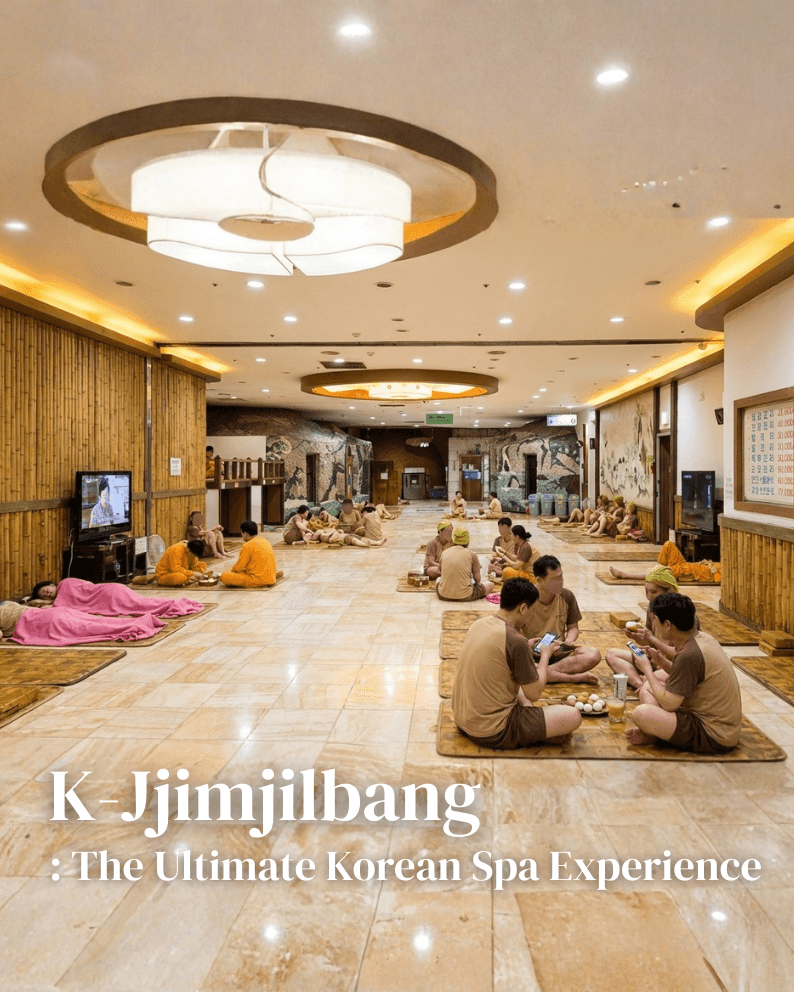

Type: K-Culture | Theme: Cultural Experience Guide | For: First-Time Visitors & K-Drama Fans
If you've watched any K-drama long enough, you've seen it: characters in matching pajamas, towels twisted into sheep ears, cracking open brown eggs on a heated floor. That's jjimjilbang (찜질방)—Korea's answer to the spa, the sleepover, and the living room, all rolled into one. Part bathhouse, part social club, part budget accommodation, these 24-hour facilities run deep in Korean daily life. And unlike most tourist attractions, this one costs less than a decent lunch.

Matching outfits, heated floors, and zero pretense—this is how Koreans unwind.
Quick Guide at a Glance
| Experience Type | Korean Spa / Bathhouse |
| Average Cost | ₩12,000-20,000 (~$9-15) |
| Time Needed | 3-12+ hours |
| Best For | Budget travelers, K-drama fans, anyone needing a real break |
| Hours | Most operate 24/7 |
| Location | Every major Korean city |
What Exactly Is a Jjimjilbang?
The word breaks down simply: jjimjil (heating/sweating) + bang (room). But the definition undersells it.
A jjimjilbang combines gender-separated bathing areas with co-ed heated rooms, sleeping quarters, snack bars, and entertainment spaces. Koreans use them after work, after drinking, after flights—or just when they need somewhere warm to exist for a few hours. The 24-hour operation means night owls and early arrivals alike treat them as de facto hotels.
Western spas emphasize pampering. Jjimjilbangs prioritize accessibility. The vibe is closer to a community center than a luxury retreat: grandmothers napping next to college students gaming on their phones, families spreading out snacks on the floor, businessmen recovering from late-night dinners. No reservations. No dress code beyond the provided uniform. No real agenda.
How It Works: A First-Timer's Walkthrough

Step one: shoes off, locker key on. The wristband doubles as your wallet inside.
Arrival & Check-In
You'll pay at the front desk (cash or card) and receive a locker key on a wristband. This key unlocks everything: your shoe locker at the entrance, your main locker in the changing room, and works as payment for any food or services inside. Keep it on your wrist the entire visit.
Staff will hand you a set of shorts and a t-shirt—the jjimjilbok (찜질복). Colors vary by facility. Everyone wears the same thing in the co-ed areas, which levels the social playing field in a way that feels oddly liberating.
What to bring: Toiletries if you're particular (basic soap/shampoo provided), a phone charger, and that's about it. Everything else—towels, sleeping mats, even toothbrushes—can be borrowed or bought inside.
The Bathing Area (Gender-Separated)
Here's the part that trips up most foreign visitors: the bathing section is nude. Completely. No swimsuits allowed.
Before entering the co-ed jjimjilbang area, you're expected to shower and soak in the baths. Hot tubs range from warm to scalding; cold plunge pools test your resolve. Some facilities add jade tubs, ginseng baths, or salt scrub stations. This isn't optional cultural immersion—it's hygiene protocol before using shared spaces.
The adjustment takes about five minutes. By minute ten, you'll forget anyone's looking. By minute thirty, you'll understand why Koreans consider this normal.
The Heated Rooms: Where the Magic Happens

Ice room on the left, traditional kiln in the center, Himalayan salt walls glowing on the right.
This is what distinguishes jjimjilbangs from ordinary bathhouses. The co-ed floor contains multiple themed rooms, each maintained at different temperatures using different materials:
Bulgama (불가마) — The traditional kiln-shaped room. Temperatures hit 70-90°C (158-194°F). Enter, lie down, sweat profusely, leave when you can't take it anymore. Time limit: most people last 10-15 minutes.
Salt Room (소금방) — Walls lined with Himalayan salt blocks. Milder heat, supposedly good for respiratory issues. The pink glow makes for decent photos.
Jade Room (옥방) — Heated jade stones. Koreans believe jade improves circulation. Temperature stays moderate, making it a popular sleeping spot.
Ice Room (얼음방) — Exactly what it sounds like. Sub-zero temperatures for cooling down between hot rooms. The contrast sends your circulation into overdrive.
Charcoal Room, Yellow Clay Room, Oxygen Room — Variations exist depending on the facility. Larger jjimjilbangs might have eight or more themed rooms.
The rotation is intuitive: heat, cool, repeat. Alternate between extreme rooms, rest in moderate ones, drink water constantly. Some visitors spend hours cycling through. Others find a comfortable spot and nap.
The Snack Ritual

The mandatory duo: cold sikhye and warm baked eggs. Don't skip this.
No jjimjilbang visit counts without sikhye and gyeran.
Sikhye (식혜) — Sweet rice punch, served ice-cold. The floating rice grains at the bottom are meant to be eaten. After cycling through heated rooms, this tastes better than anything at a five-star restaurant. ₩3,000-4,000 per cup.
Maekbanseok Gyeran (맥반석 계란) — Eggs baked slowly in mineral stone ovens for hours. The shells turn brown, the whites become slightly sweet, the texture goes silky. Crack them on your forehead like locals do—it's tradition, not performance. ₩1,000-1,500 for 3-4 eggs.
Both items appear in approximately 90% of K-drama jjimjilbang scenes. The combination hits differently when you're actually sweating in a heated room surrounded by strangers in matching clothes.
The Sheep Head Towel: Your New Skill

Master this, and you've earned your jjimjilbang credentials.
The yangmeori (양머리, "sheep head") towel twist became a K-drama staple for good reason: it's genuinely useful. The rolled edges absorb sweat. The shape keeps the towel secure. And yes, everyone looks equally ridiculous, which is part of the charm.
Quick tutorial:
- Fold a small towel in half lengthwise
- Roll both ends toward the center, leaving the middle flat
- Open the center fold and place it on your head
- The rolled sides become "ears"
YouTube tutorials exist if text instructions don't click. But honestly, just ask any Korean nearby. Teaching foreigners the sheep fold is a point of pride.
The Common Area: More Than Just Rest

TV dramas playing, manhwa stacked nearby, families sprawled across heated floors—this is Korean leisure time.
The jjimjilbang common area functions as a public living room. Heated floors (ondol) let visitors spread out with blankets and pillows. TVs broadcast whatever's popular—usually dramas or variety shows. Stacks of manhwa (Korean comics) line the walls.
Some visitors genuinely sleep here, especially those using jjimjilbangs as overnight accommodations. Others play board games, catch up on phones, or simply exist in comfortable silence. The atmosphere runs closer to a library than a party.
Additional facilities vary by location:
- PC rooms (gaming stations)
- Noraebang (karaoke rooms)
- Massage chairs
- Kids' play areas
- Full restaurants beyond the snack bar
- Nail salons, barber shops, skincare stations
Larger facilities like Dragon Hill Spa in Seoul or Spa Land in Busan resemble small villages more than bathhouses.
Practical Tips for First-Timers
Timing matters. Weekday afternoons draw smaller crowds. Weekend evenings pack with families and groups. Late night (after 11 PM) brings a quieter, mostly-sleeping atmosphere.
The nude bathing section is non-negotiable. If this feels uncomfortable, know that: (a) everyone focuses on their own bathing, (b) the average Korean finds body shame more puzzling than nudity, and (c) you can minimize time there by showering quickly before heading to the co-ed areas.
Hydrate aggressively. The heated rooms dehydrate you faster than you'd expect. Water fountains and vending machines dot every floor. Use them.
Tattoos may cause issues. Some facilities prohibit visible tattoos in bathing areas due to yakuza associations. Policies vary—call ahead if concerned, or choose foreigner-friendly spots like Dragon Hill Spa.
Overnight stays work. Jjimjilbangs accept visitors staying until morning. You won't get a private room (unless you pay extra at premium facilities), but sleeping mats, blankets, and relatively quiet corners make budget accommodation viable.
Don't bring valuables you'd stress about. Lockers exist, but large jjimjilbangs see thousands of visitors daily. Leave the expensive camera at your hotel.
Where to Go: Top Recommendations
Seoul
Dragon Hill Spa (용산) — The foreigner-friendly default. Seven floors, outdoor pools, multiple restaurants, English signage. ₩20,000 (day) / ₩25,000 (overnight). Yongsan Station, Exit 1.
Siloam Sauna (서울역) — More authentic local vibe, fewer tourists. ₩12,000. Near Seoul Station.
Spa Lei (강남) — Women-only, newer facilities, premium feel. ₩22,000.
Busan
Spa Land Centum City — Inside Shinsegae Department Store, consistently ranked among Korea's best. 22 themed rooms, outdoor foot bath, impeccable maintenance. ₩18,000-20,000.
Hurshimchung Spa — Uses natural hot spring water. ₩15,000.
Other Cities
Termeden (이천) — Outdoor hot spring resort an hour from Seoul. More destination spa than neighborhood jjimjilbang, but worth the trip.
FAQ
Q: Is jjimjilbang appropriate for families with children? A: Absolutely. Many facilities include dedicated kids' areas, and Korean families regularly bring children of all ages. The co-ed areas (in matching clothes) make it comfortable for mixed-gender family groups.
Q: Can I visit during my period? A: The bathing section would be uncomfortable, but you can skip the pools and head directly to the co-ed jjimjilbang floor. Some visitors do this regardless of circumstances.
Q: What if I have tattoos? A: Policies vary. Dragon Hill Spa in Seoul explicitly welcomes tattooed guests. Smaller neighborhood jjimjilbangs may ask you to cover them or restrict access to bathing areas. When uncertain, call ahead.
Closing
Jjimjilbang sits at the intersection of Korean practicality and communal culture—affordable, unpretentious, open to anyone willing to wear matching pajamas and sweat alongside strangers. It's the kind of place that sounds strange until you try it, then feels obvious afterward. Budget a half-day minimum. Bring an open mind about the nude bathing situation. And don't leave without attempting the sheep towel.
📌 Quick Reference Card
| Item | Details |
| Topic | K-Jjimjilbang Complete Guide |
| Type | Cultural Experience |
| Cost Range | ₩12,000-25,000 (~$9-19) |
| Time Needed | 3-12+ hours |
| Best For | Budget travelers, K-drama fans, cultural experience seekers |
| Top Picks | Dragon Hill Spa (Seoul), Spa Land (Busan), Siloam Sauna (Seoul) |
| Useful Links | VisitKorea.or.kr, each facility's Naver page |