

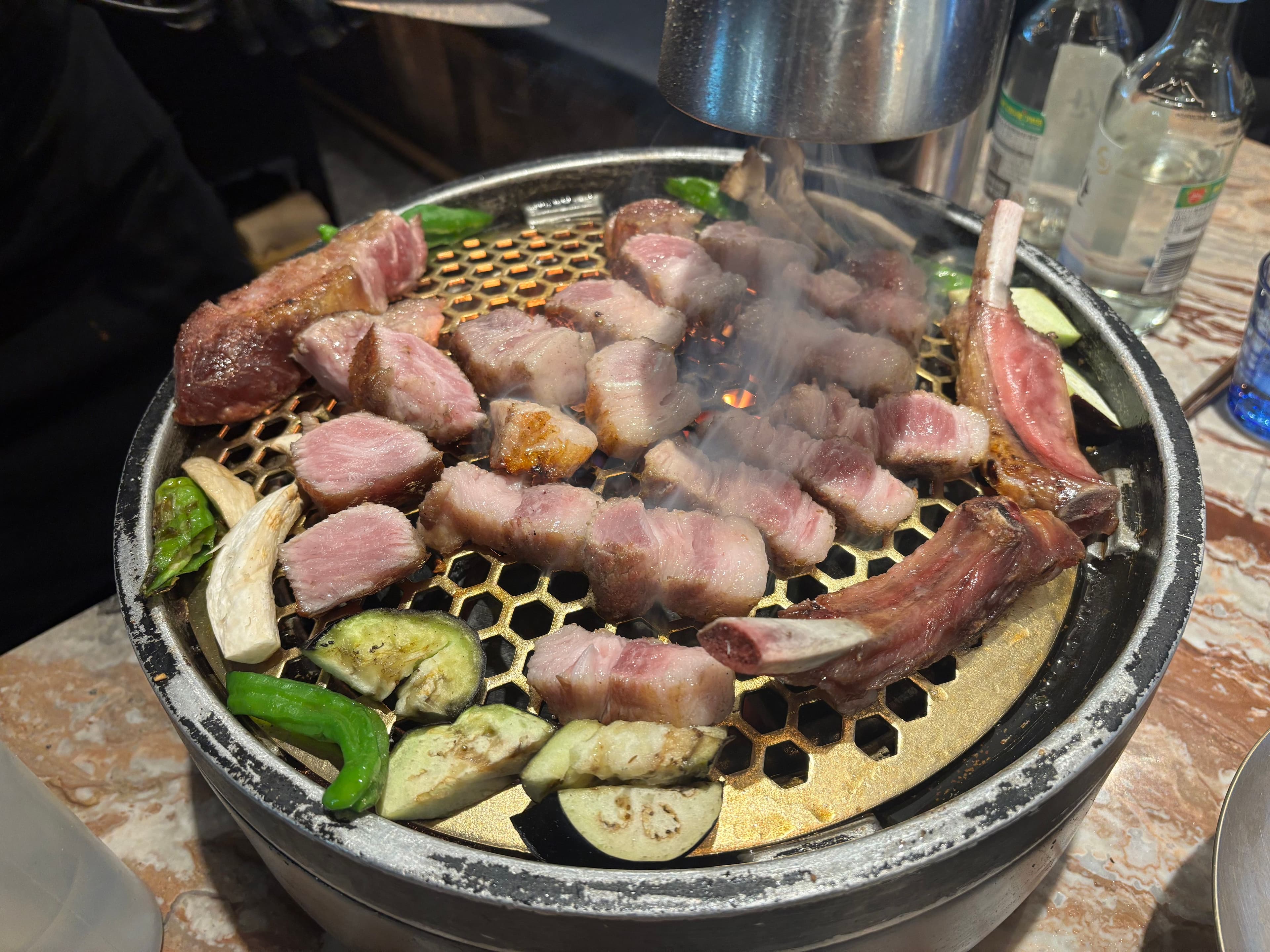

Type: Main Dish / Social Dining | Price Range: ₩15,000-50,000 (~$11-37) per person | Best For: Groups, Soju lovers, First-timers to adventurous eaters
Thick slabs of pork belly sizzling over charcoal. Fat rendering into crispy edges while smoke rises through the overhead vents. Korean BBQ runs ₩15,000-50,000 per person depending on your cut selection, and most restaurants expect a minimum order of two servings. The ritual involves grilling your own meat at the table, wrapping it in lettuce with garlic and fermented bean paste, then washing it down with soju or beer.
This guide covers five essential cuts—from crowd-pleasing samgyeopsal to the more daring gopchang—plus ordering tips and grilling techniques that locals actually use.

A typical K-BBQ spread with meat, vegetables, and banchan surrounding the grill
At a Glance
| Food Type | Grilled Pork & Offal |
| Price Range | ₩15,000-50,000 (~$11-37) per person |
| Minimum Order | Usually 2 servings per meat type |
| Best Areas | Mapo-gu, Jongno, Sinchon |
| Best Time | 7-10 PM for full atmosphere |
| Alcohol Pairing | Soju, beer, or *somaek* (mix) |
What Makes Korean BBQ Different
The grill sits at the center of the table. No chef prepares your food in a distant kitchen—you cook it yourself, or a server handles the grilling if you're at a full-service spot. Most Korean BBQ restaurants specialize in either pork (dwaeji) or beef (hanwoo/soegogi), rarely both at the same quality level.
Pork dominates the casual K-BBQ scene. It costs less than beef, takes well to various marinades, and pairs naturally with soju. The banchan (side dishes) arrive free and get refilled on request: kimchi, pickled radish, sliced raw garlic, green onion salad, and ssamjang (a thick, savory-spicy dipping paste).
Locals rarely eat K-BBQ alone. The social element—sharing the grill, taking turns flipping meat, pouring drinks for each other—matters as much as the food itself.
The Five Essential Cuts
Samgyeopsal (삼겹살) — Pork Belly
Price: ₩14,000-18,000 per serving (~$10-13) | Difficulty: Beginner-friendly

Thick-cut samgyeopsal with marbled fat layers ready for grilling
The default K-BBQ order. Sam-gyeop-sal translates to "three-layer meat," referring to the alternating bands of fat and lean pork. Slices run 1-1.5cm thick, and one serving typically includes 150-200g.
The goal: crispy edges, rendered fat, slightly charred exterior. Cook each side for 2-3 minutes over high heat. Cut into bite-sized pieces with scissors once the fat turns golden and translucent.

The proper ssam technique: lettuce, meat, garlic, green onion, and ssamjang
The wrap method: Lay a lettuce leaf flat. Add a piece of grilled meat, a slice of raw garlic, some green onion salad, and a small dab of ssamjang. Fold and eat in one bite. Koreans consider it bad luck to take two bites of a single ssam.
Moksal (목살) — Pork Neck
Price: ₩15,000-19,000 per serving (~$11-14) | Difficulty: Beginner-friendly
Cut from the neck and shoulder area, moksal has finer marbling than samgyeopsal with less overall fat. The meat stays tender without becoming greasy—a favorite among those who find pork belly too rich.
Grill moksal the same way as samgyeopsal, but watch it more closely. Less fat means it can dry out faster. The ideal doneness shows a slight pink center with caramelized edges. Dip in sesame oil mixed with salt and pepper (gireum-jang) for the cleanest flavor.
Dwaeji Galbi (돼지갈비) — Marinated Pork Ribs
Price: ₩16,000-22,000 per serving (~$12-16) | Difficulty: Easy

Sweet-savory marinated pork ribs caramelizing on a charcoal grill
Pre-marinated in a sweet soy-based sauce with garlic, ginger, and often pear or apple juice for tenderizing. The sugar content means dwaeji galbi burns easily—keep the heat moderate and flip frequently.
The marinade caramelizes into a sticky, lacquered glaze. Bones make these ribs messier to eat than boneless cuts, but the meat near the bone carries the most flavor. No dipping sauce needed; the marinade does the work.
Worth noting: Some restaurants serve yangnyeom galbi (양념갈비), which uses a spicier gochujang-based marinade. Ask before ordering if you're heat-sensitive.
Gopchang (곱창) — Small Intestines
Price: ₩18,000-28,000 per serving (~$13-21) | Difficulty: Intermediate

Seasoned gopchang with characteristic curled texture, grilled until crispy
Here's where K-BBQ gets interesting. Gopchang refers to pork or beef small intestines, cleaned thoroughly and often pre-seasoned with gochugaru (red pepper flakes). The texture sits somewhere between chewy and springy, with a rich, fatty interior that melts when cooked properly.
The key to good gopchang: high heat and patience. The exterior should turn golden and slightly crispy while the inside stays soft. Undercooked gopchang feels rubbery; overcooked becomes tough. Look for a slight char and listen for the sizzle to quiet down.
Gopchang pairs exceptionally well with cold beer. Many Koreans treat it as anju (drinking food) rather than a main meal.
Makchang (막창) — Large Intestines
Price: ₩20,000-30,000 per serving (~$15-22) | Difficulty: Advanced

Makchang on a flat grill alongside other offal cuts
The boldest flavor on this list. Makchang comes from the last section of the pig's large intestine, with a thicker wall and chewier bite than gopchang. The taste runs richer—almost gamey—and the aroma can be strong during grilling.
First-timers often prefer gopchang's milder profile. But for those who enjoy organ meats, makchang delivers a satisfying chew and concentrated pork flavor. Dip in gireum-jang (sesame oil with salt) or the restaurant's house sauce to balance the intensity.
The catch: Quality varies significantly between restaurants. A good makchang spot cleans and prepares the intestines meticulously. A mediocre one... you'll know by the smell.
How to Grill Like a Local
Most K-BBQ restaurants use one of three grill types: charcoal, gas, or electric. Charcoal gives the best flavor but requires more attention. Gas and electric run cleaner with easier temperature control.
Basic technique:
- Wait until the grill heats fully—a drop of water should sizzle and evaporate instantly
- Place meat around the edges first, moving to the center as it cooks
- Flip only once or twice; constant flipping prevents proper browning
- Cut into pieces with scissors after cooking, not before
- Don't overcrowd—leave space between pieces for even heat distribution
Temperature management: If flames flare up from dripping fat, move the meat aside or request a grill change. Most restaurants swap out grills mid-meal at no extra charge.
Drink Pairings
Soju (소주) — The classic match. A 360ml bottle runs ₩5,000-6,000 at most BBQ joints. The neutral, slightly sweet spirit cuts through fatty meat.
Beer (맥주) — Cass and Hite dominate. A 500ml glass costs ₩4,000-5,000. Light lagers that refresh the palate between bites.
Somaek (소맥) — Soju + beer mixed at roughly 3:7 ratio. Smoother than straight soju, more interesting than plain beer.
Makgeolli (막걸리) — Milky rice wine with a slight fizz. Pairs particularly well with gopchang and makchang. Order by the bottle (₩8,000-12,000).
How to Order
Useful phrases:
- Samgyeopsal i-inbun juseyo (삼겹살 2인분 주세요) — "Two servings of pork belly, please"
- Banchan deo juseyo (반찬 더 주세요) — "More side dishes, please"
- Bul jom jullyeo juseyo (불 좀 줄여 주세요) — "Please lower the heat"
Standard order for 2-3 people:
- 2-3 servings of samgyeopsal or moksal
- 1 serving of dwaeji galbi
- Optional: 1 serving of gopchang if adventurous
- 1-2 bottles of soju or beer
Menu terms:
- Saeng (생) — Fresh/unmarinated
- Yangnyeom (양념) — Marinated/seasoned
- Gui (구이) — Grilled
- Modum (모듬) — Assorted platter
Practical Tips
Timing matters. Peak hours (7-9 PM) mean waits of 20-40 minutes at popular spots. Lunch service (11 AM-2 PM) runs quieter with the same menu.
Clothes will smell. The smoke permeates everything. Wear something you don't mind washing afterward, or use the coat hooks away from the grill area.
Minimum orders apply. Most restaurants require at least 2 servings (2인분) per meat type. Solo K-BBQ diners should look for 1인 삼겹살 spots, which have smaller portions.
Refills are free. Banchan, lettuce wraps, and garlic get replenished at no charge. Just ask.
Scissors and tongs. Each table has both. Scissors cut the meat; tongs flip it. Using your personal chopsticks to handle raw meat is considered poor form.
Service bells. Press the button on your table for attention. Servers won't hover, so you'll need to call them when ready to order more or need the check.
Final Verdict
For ₩25,000-40,000 per person including drinks, K-BBQ delivers a full meal and a social event in one package. The interactive cooking keeps everyone engaged, and the variety of cuts means something for every preference level.
Try if: You want hands-on dining, enjoy fatty meats, or want to experience Korean drinking culture firsthand.
Skip if: You're vegetarian, prefer quick meals, or strongly dislike smoky environments.
Samgyeopsal remains the safest starting point. Once comfortable, work your way toward moksal and dwaeji galbi. Gopchang and makchang reward the curious eater willing to try something outside the usual comfort zone.
📌 Quick Reference
- Best areas: Mapo-gu (Hongdae/Hapjeong), Jongno (Jongno 3-ga), Sinchon
- Average price: ₩25,000-40,000 per person with drinks
- Reservation: Rarely needed except weekends at famous spots
- Dietary info: Not suitable for vegetarians; gluten in some marinades
- Related dishes: Beef BBQ (hanwoo), Chicken BBQ (dak-galbi), Grilled duck (ori-gui)