


Region: Incheon, Jung-gu | Theme: History / Architecture / Culture | Ideal Trip Length: 1 day
Incheon opened to foreign trade in 1883, making it Korea's first window to Western modernity. Coffee, railways, postal services, electric lights—most arrived here first. Today, the Open Port Cultural District (Gaehangjiang, 개항장) compresses that entire era into a walkable neighborhood where Japanese-colonial shophouses line one street, Chinese-style architecture dominates another, and a 19th-century expat social club sits beneath Korea's oldest Western-style park. This guide maps out seven key stops, with timing, routes, and the practical details to shape your own circuit.

Quick Plan at a Glance
| Best Time to Go | Spring (April-May) or Fall (September-October) for mild weather; weekdays for fewer crowds |
| How to Get Around | Entirely on foot; all spots within 15-minute walking radius |
| Who This Is For | History enthusiasts, architecture fans, K-drama location hunters, photographers |
| Total Time Needed | 5-7 hours (including meals) |
| Number of Spots | 7 |
Chinatown & Jajangmyeon Museum — 차이나타운 & 짜장면박물관
The food connection draws most visitors here first. Incheon's Chinatown is where jajangmyeon—Korea's beloved black bean noodles—was invented in 1905, adapted by Chinese dock workers for local tastes. That origin story alone makes this the district's most-visited section.
The Jajangmyeon Museum occupies the former site of Gonghwachun, the restaurant credited with popularizing the dish. Inside, six exhibition halls trace the noodle's evolution: a recreated 1930s Chinese restaurant dining room, vintage delivery boxes (cheolgabang), and walls of instant jajangmyeon packaging from different decades.
Beyond the museum, the neighborhood itself rewards slow walking. Red-and-gold gates frame the entrance. Steep alleys climb toward murals depicting scenes from Romance of the Three Kingdoms. Bakeries sell wolbyeong (moon cakes) and gonggal-ppang (hollow fried bread) using recipes passed down through generations of Hwagyo (ethnic Chinese) families.

Getting There: Exit Incheon Station (Line 1 / Suin-Bundang Line), cross the plaza, walk through the main gate
Time Needed: 1-1.5 hours (museum + neighborhood stroll)
Cost: Museum ₩1,000 (~$0.75)
Hours: 09:00-18:00, closed Mondays
📍 56-14 Chinatown-ro, Jung-gu, Incheon
Jayu Park — 자유공원
Korea's first Western-style public park predates Seoul's Tapgol Park by nine years. Designed by Russian surveyor Sabatin in 1888 for the foreign residents of Incheon's various concession zones, it originally went by "Gakguk Park" (Park of All Nations). The current name—"Freedom Park"—dates to 1957, when a statue of General Douglas MacArthur was installed to commemorate the Incheon Landing that turned the tide of the Korean War.
The park draws steady foot traffic year-round: cherry blossoms in April, autumn foliage in November, and unobstructed sunset views over the harbor any evening. From the main plaza, the port's container cranes and the West Sea stretch to the horizon.
What makes it popular with foreign visitors: the combination of historical weight and accessibility. A single hilltop location holds Korea's first modern park, a Korean War monument, and panoramic city views—all free, all open around the clock.

Best Time: Late afternoon for golden-hour light on the harbor
Time Needed: 45 minutes - 1 hour
Getting There: 10-minute uphill walk from Chinatown via the Three Kingdoms Mural Alley
Cost: Free
Hours: Open 24 hours
📍 Jayugongwonnam-ro, Songhak-dong, Jung-gu
Jemulpo Club — 제물포구락부
This two-story brick building pulls consistent interest from K-drama fans—it appeared in tvN's Goblin (도깨비)—but the actual history runs deeper. Built in 1901 by Ukrainian architect Sabatin (the same designer behind Jayu Park), it served as a members-only social club for Western diplomats and merchants stationed in Incheon during the treaty-port era.
The interior held a library, billiard room, and ballroom. Tennis courts occupied the adjacent grounds. As Japan tightened control over Korea, Western members gradually departed, and the building cycled through various uses: Japanese veterans' association hall, U.S. military officers' club after liberation, and eventually Incheon's first public museum (1953-1990).
A 2007 restoration returned the structure to its early-1900s appearance. Current exhibitions rotate, but the permanent displays focus on Incheon's international exchange history through photographs, period furniture, and multilingual signage.

Why visitors come: Architectural rarity (few treaty-port-era Western buildings survive in Korea) plus the Goblin connection
Time Needed: 30-45 minutes
Getting There: Inside Jayu Park, downhill from the main plaza
Cost: Free
Hours: 09:30-17:30, lunch break 12:00-13:00
📍 25 Jayugongwonnam-ro, Jung-gu
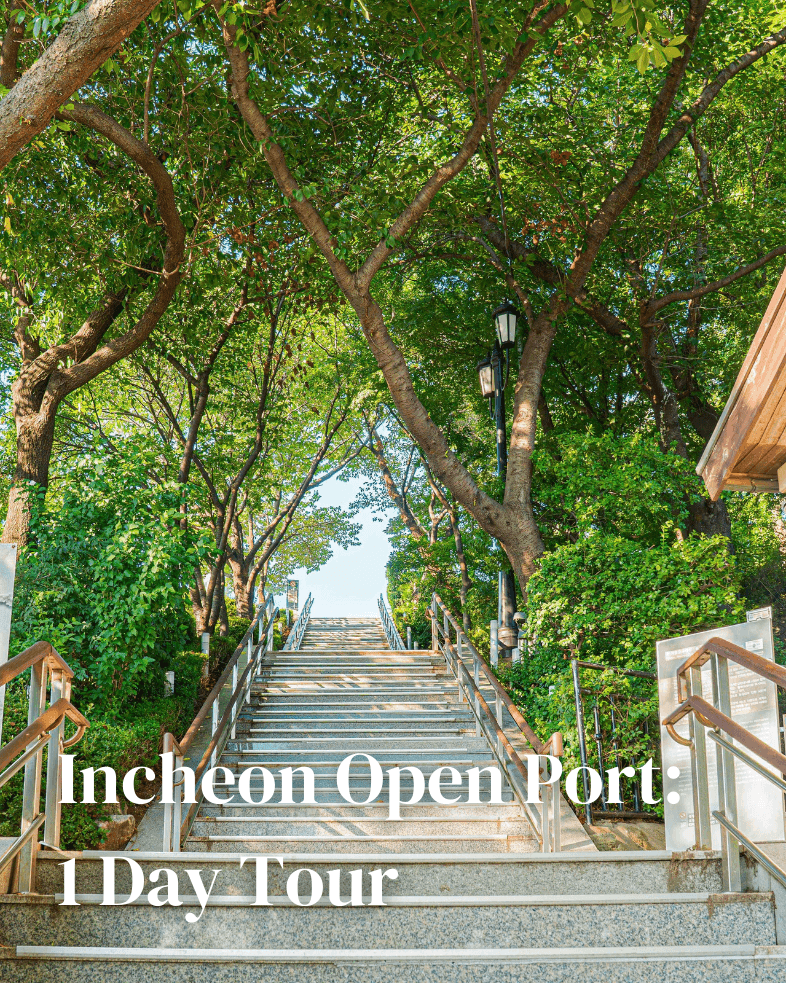
Sino-Japanese Settlement Boundary Stairs — 청일조계지 경계계단
Here's where the district's layered history becomes physically visible. These stone stairs once marked the literal border between the Chinese and Japanese concession zones established in the 1880s. Stand at the bottom and look up: the left side belonged to China, the right to Japan.
That division still reads in the architecture. Chinese-style stone lanterns (square bases, ornate carvings) line one flank; Japanese-style lanterns (octagonal tops with curved finials) line the other. At the top sits a Confucius statue, a gift from Qingdao in 1993.
The stairs themselves were likely constructed in the late 1880s or early 1890s, originally to provide access to the customs director's residence on the hill. As both nations expanded their concessions, the stairway became a de facto boundary marker—two empires staking claims on Korean soil, separated by a stone median.

Photo angle: Shoot from the base looking upward to capture both lantern styles in a single symmetrical frame
Time Needed: 15-20 minutes
Getting There: At the top of the Three Kingdoms Mural Alley, adjacent to Chinatown
Cost: Free
Hours: Open-air site, accessible anytime
📍 Seonlin-dong, Jung-gu (Incheon Monument No. 51)
Incheon Open Port Museum — 인천개항박물관
The building itself is the first exhibit. This stone-and-brick structure housed Japan's Dai-Ichi Bank Incheon Branch starting in 1883—the first modern bank on the Korean peninsula. The arched doorway, domed cupola, and thick granite walls remain intact; the interior has been converted into four permanent galleries.
Displays trace how Western goods and systems entered Korea through Incheon: a life-sized model of Korea's first postman, railway memorabilia from the Gyeongin Line (Korea's inaugural rail route), and the original bank vault—now reframed as an exhibit on colonial-era financial extraction.
The museum works well as an orientation stop early in your visit. Context gathered here—timelines, maps, photographs—adds depth to the streets you'll walk afterward.

Time Needed: 45 minutes - 1 hour
Getting There: 5-minute walk from Chinatown, on the main museum street
Cost: ₩500 (~$0.40) or ₩3,400 (~$2.50) for 5-museum combo ticket
Hours: 09:00-18:00, closed Mondays
📍 89 Sinpo-ro 23beon-gil, Jung-gu
Korea Modern Literature Museum — 한국근대문학관
Converted from a 1930s-40s shipping warehouse, this museum holds a specific appeal: the literary record of Korea's turbulent transition from dynasty to colony to divided nation. Manuscripts, first editions, and personal effects from writers active between the 1890s and 1940s fill two floors of industrial-chic exhibition space.
The connection to Incheon isn't arbitrary. As the port where foreign ideas first arrived, the city shaped the intellectual currents that would define Korean modernism. Writers documented that collision—tradition meeting industrialization, Korean identity under colonial pressure.
Exhibits rotate, but permanent collections include original printings of landmark works, vintage typewriters, and recreated editorial offices. English signage exists, though Korean-language materials dominate.

Best for: Literature enthusiasts, design-focused visitors drawn to the industrial-warehouse aesthetic
Time Needed: 30-45 minutes
Getting There: 3-minute walk from Incheon Open Port Museum
Cost: Free
Hours: 10:00-18:00, closed Mondays
📍 76 Sinpo-ro 15beon-gil, Jung-gu
Open Port Cultural Street — 개항장 문화의 거리
Rather than a single destination, this is the connective tissue linking everything else. The streets between Incheon Station and Jayu Park hold dozens of early-20th-century structures—former Japanese trading houses, colonial-era banks, consular residences—most now converted to cafes, galleries, or small museums.
Architectural variety defines the area. Japanese wooden shophouses with dark timber frames and ceramic roof tiles stand next to Western-style stone buildings. Some retain original signage; others have been adapted with contemporary interiors behind preserved facades.
Worth seeking out: the Modern Architecture Exhibition Hall (a former Japanese bank, ₩500 entry), Incheon Art Platform (1930s warehouses turned artist residencies), and the various retro-themed cafes occupying jeoksan-gaok (Japanese-style colonial houses). The neighborhood rewards aimless wandering as much as targeted visits.
Photo strategy: Early morning or late afternoon for soft light on the building facades; weekdays for emptier streets
Time Needed: Factor 1-1.5 hours of walking time into your schedule
Landmarks: Naeri Church (Anglican, 1891), Dapdong Cathedral (Catholic, 1897), Jungdong Post Office (Japan's first in Korea)
📍 Sinpo-ro area, Jung-gu
Suggested Itinerary: Full-Day Route
This sequence minimizes backtracking while building historical context as you go.
Distance: Approximately 3-4 km total walking
Elevation: One moderate hill (Jayu Park)
Alternative: Reverse the route if you prefer ending with food in Chinatown
Practical Tips
Combined ticket strategy. The 5-museum pass (₩3,400) covers the Open Port Museum, Modern Architecture Exhibition Hall, Jajangmyeon Museum, Daebuil Hotel Exhibition Hall, and Hanjung Cultural Center. Worth it if you plan to enter three or more.
Guided tours. Free docent-led walking tours run for groups of 10+ with three days' advance booking (032-752-3545). Korean-language only, but self-guided English maps are available at the tourist information center near Incheon Station.
Timing crowds. Weekday mornings see the lightest foot traffic. Weekend afternoons—especially in Chinatown—can get congested with domestic tour groups.
Footwear matters. The district involves cobblestones, stairs, and park trails. Comfortable walking shoes are essential.
Accessibility note. Jayu Park requires stair climbing; wheelchair access is limited. The museum street and Chinatown are largely flat.
Food beyond jajangmyeon. Sinpo International Market (5-minute walk) has dakgangjeong (sweet crispy chicken), a local specialty. Chinatown bakeries sell hwagwa (Chinese-style pastries) ideal for afternoon snacks.
FAQ
Q: How do I get to Incheon Open Port District from Seoul? A: Take Seoul Metro Line 1 to Incheon Station (terminal stop). The ride from Seoul Station takes approximately 70 minutes on the regular train or 50 minutes via express. Incheon Station sits directly at the edge of the district.
Q: Is one day enough to see everything? A: For the core sites covered here, yes. A single day allows thorough exploration of all seven spots with time for meals. Adding nearby Wolmido Island or Songwol-dong Fairytale Village would require a second day.
Q: Are English explanations available at the museums? A: Most museums have bilingual (Korean/English) signage for major exhibits. The Jajangmyeon Museum and Open Port Museum have the most comprehensive English materials. The Literature Museum skews more Korean-language dominant.
📌 Quick Reference Card
| Item | Details |
|---|---|
| Topic | Incheon Open Port History Tour |
| Region | Jung-gu, Incheon |
| Best Season/Time | Spring or Fall; weekday mornings |
| Total Time Needed | 5-7 hours |
| Spots Covered | Jajangmyeon Museum, Jayu Park, Jemulpo Club, Boundary Stairs, Open Port Museum, Literature Museum, Cultural Street |
| Getting Around | Walking only |
| Getting There | Seoul Metro Line 1 → Incheon Station (50-70 min) |
| Useful Links | [Incheon Tourism](https://itour.incheon.go.kr/), [Open Port District Info](https://www.incheonopenport.com/) |
Incheon's Open Port District compresses 140 years of transformation into a single afternoon's walk. The museums document the facts; the streets themselves hold the atmosphere. For travelers looking to understand how Korea became modern, this is where that story starts.