

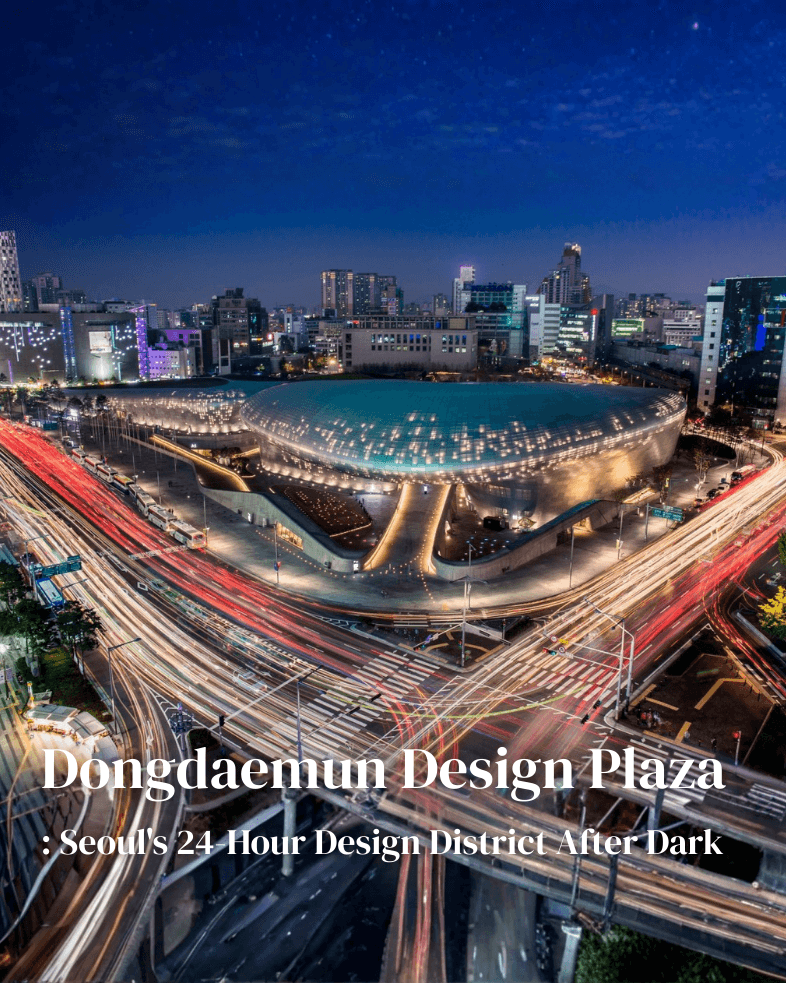

Location: Jung-gu, Seoul | Category: Architecture & Culture Complex | Best For: Architecture enthusiasts, Night photographers, Design lovers
A 280-meter curved structure clad in 45,133 aluminum panels—no two identical—rises from the former site of Seoul's oldest stadium. Dongdaemun Design Plaza (DDP), designed by the late Pritzker Prize-winner Zaha Hadid, welcomed over 100 million visitors within its first decade. This guide breaks down what to see, when to go, and how to make the most of Seoul's round-the-clock design landmark.

The curved aluminum facade glows against Seoul's nightscape, with traffic trails framing what locals call "the spaceship that landed in Dongdaemun"
At a Glance
| Address | 281 Eulji-ro, Jung-gu, Seoul (서울특별시 중구 을지로 281) |
| Outdoor Areas | Open 24 hours |
| Exhibition Halls | Tue, Thu, Sat, Sun: 10:00-19:00 / Wed, Fri: 10:00-21:00 / Closed Mondays |
| General Admission | Free (exterior, LED Rose Garden, rooftop park) |
| Paid Exhibitions | ₩10,000-20,000 (~$7-14 USD) depending on exhibition |
| Time Needed | 1.5-3 hours |
| Best Time | Weekday evenings after 7 PM for minimal crowds |
Why Visit?
DDP breaks from traditional Korean architecture entirely. The building's neofuturistic curves were generated using fluid simulation software—Hadid's team observed Han River flow patterns and translated that movement into frozen structural form.
Construction required Korea's first full-scale use of 3D Building Information Modeling (BIM). Each of those 45,133 exterior panels has different dimensions and curvature. Roughly 50% are double-curved, 30% single-curved, and 20% flat or cold-bent. The result changes appearance throughout the day: silver-gray at noon, warm gold at sunset, and a massive canvas for projection mapping after dark.
The numbers back up its draw. DDP reached 100 million cumulative visitors by June 2024, with 13.75 million visitors in 2023 alone (Seoul Metropolitan Government, 2024). December consistently peaks as the busiest month, driven by the Seoul Light DDP media facade festival. The complex was named to The New York Times' "52 Places to Go" and won the 2023 Red Dot Design Award for its media art programming.
What to See
Architecture & Outdoor Spaces
Start at Oullim Square, the sunken plaza directly connected to Dongdaemun History & Culture Park Station (Exit 1). This is where fashion shows, outdoor markets, and countdown events take place. The massive concrete pillars supporting the structure overhead create dramatic shadows for photography.

Weekend busking performances fill Oullim Square, where the building's structural supports frame an impromptu open-air venue
Walk the Design Dulle-gil (Design Trail)—a looping pathway that ascends to the rooftop park. The route passes excavated sections of the old Seoul fortress wall and the Igansumun floodgate, discovered during construction. These 600-year-old relics sit alongside the futuristic curves, an unplanned contrast between dynastic-era stonework and 21st-century parametric design.
The rooftop itself is a 30,000-square-meter landscaped park with no single focal point—intentionally designed following traditional Korean garden principles where no feature dominates the perspective.
LED Rose Garden
The most photographed spot at DDP sits beside the Yigansumun Exhibition Hall. Started as a temporary installation in April 2015, the 25,550 LED roses became permanent after overwhelming demand. They turn on automatically at dusk and glow until late evening.

25,550 LED roses bloom nightly beside DDP's silver curves—a permanent installation after its 2015 temporary run proved too popular to remove
Weekends after 8 PM draw couples and selfie crowds. For clearer shots, arrive on weekday evenings around 7 PM, just after the lights activate.
Seoul Light DDP (Media Facade)
The 222-meter main facade transforms into Korea's largest projection-mapping surface during seasonal festivals. Running since 2019, Seoul Light DDP holds the Guinness World Record for the world's largest amorphous architectural 3D projection display.
2025 programming expanded to three annual editions: summer (late July-early August), autumn (late August-early September), and winter (mid-December through New Year's Eve). Shows run 8:00-10:00 PM during festival periods. Free admission.

Waves crash across 45,000 aluminum panels during Seoul Light DDP—the world's largest amorphous 3D projection-mapped display
For the best viewing angle, position yourself along Jangchungdan Street (장충단로) facing the main facade, or at the plaza connecting Exit 1 to the building entrance.
Exhibitions & Museums
DDP houses rotating paid exhibitions across multiple halls. Quality varies—some are blockbuster international shows, others are commercial pop-up experiences. Check ddp.or.kr before visiting to see what's running.

"Next Hi-Light" showcases emerging Korean designers—DDP's curving interior provides unexpected backdrops for contemporary furniture and sculpture

Major traveling exhibitions like the Jean-Michel Basquiat retrospective draw international crowds to DDP's museum halls
The Design Museum maintains a permanent collection of Korean design history. The Design Lab operates as an incubator for emerging product designers. Both are smaller than the main exhibition halls but worth a walk-through.

Thematic exhibitions at DDP often challenge conventional display formats—"Ultra Department Store Seoul" questioned consumer culture through warehouse-style installations
Getting There
Subway (fastest option): Dongdaemun History & Culture Park Station (동대문역사문화공원역) on Lines 2, 4, and 5.
- Exit 1: Direct connection to Oullim Square. Elevator available.
- Exit 2: Alternative route to ground level.
Walk time from exit to main plaza: under 2 minutes.
From Dongdaemun Station (Lines 1, 4): Exit 7, then 5-minute walk south.
By Taxi: Show drivers: "동대문디자인플라자" (Dongdaemun Design Plaza) or "DDP"
Airport Limousine: Bus 6702 from Incheon Airport stops at nearby hotels including The Splaisir Seoul Dongdaemun.

DDP's curves catch the first light of the new year, photographed from the neighboring Migliore shopping complex
Special Events & Programs
Seoul Fashion Week
Held twice yearly (March and October) at DDP. The Art Hall and outdoor spaces convert to runway venues. Public access varies by show—some require invitations, others are open.
Seoul Design Week
Annual October event bringing international designers, industry talks, and public installations. Attendance hit 1.12 million in 2023.
New Year's Countdown
DDP has become Seoul's alternative countdown venue to Bosingak Bell. The 2024-2025 event featured fireworks, artist performances, and media facade projections. Free attendance, but arrive early—crowds build from 9 PM.
Practical Tips
Photography timing: Golden hour (sunset) catches the aluminum panels at their warmest. Blue hour (just after sunset) is ideal for balancing building lights with lingering sky color. Night shots of the media facade require a tripod—handheld images blur at the slow shutter speeds needed.
Crowd patterns: Monday closures for exhibition halls mean Tuesday mornings see the lightest foot traffic. Weekend evenings from 8-10 PM are busiest, especially during Seoul Light festival periods. December crowds peak around the countdown event.
Combine with Dongdaemun shopping: The surrounding fashion malls (Doota, Migliore, APM Place) operate until 5 AM. A common pattern: evening at DDP, late-night shopping, then dawn departure.
Weather considerations: The rooftop park and outdoor areas have minimal shelter. Avoid during monsoon season (late June-July) or when fine dust warnings are active. Winter visits pair well with Seoul Light DDP but expect temperatures below freezing after 9 PM.
Accessibility: Elevators serve all levels. The Design Dulle-gil trail has some slopes but is wheelchair-accessible with assistance.
Is It Worth It?
The exterior, rooftop park, and LED Rose Garden cost nothing. That alone justifies a stop—the architecture delivers something you won't find elsewhere in Seoul or most cities worldwide.
Paid exhibitions are hit-or-miss. Check reviews before purchasing tickets. The venue itself often outshines what's displayed inside it.
Go if: You photograph architecture, want to experience Seoul Light DDP during a festival run, or need a free evening activity that stays open past midnight.
Skip if: You're seeking traditional Korean culture (head to Bukchon or Gyeongbokgung instead) or dislike crowds (Seoul Light events draw hundreds of thousands over their run).
For ₩0, you get 30,000 square meters of walkable park, one of the world's largest parametric buildings, and a permanent LED rose garden. Few landmarks anywhere ask so little for so much.
📌 Quick Reference
- Official site: ddp.or.kr (English available)
- Real-time updates: @ddp_seoul (Instagram)
- Info hotline: ☎ 02-2153-0000 (Korean/English, 9 AM-6 PM)
- Seoul Light DDP updates: Seoul Metropolitan Government Events
- Location: 281 Eulji-ro, Jung-gu, Seoul