


Location: Jongno-gu, Seoul | Category: Scenic Viewpoint / Drive Course | Best For: Night photography, Couples, Solo travelers
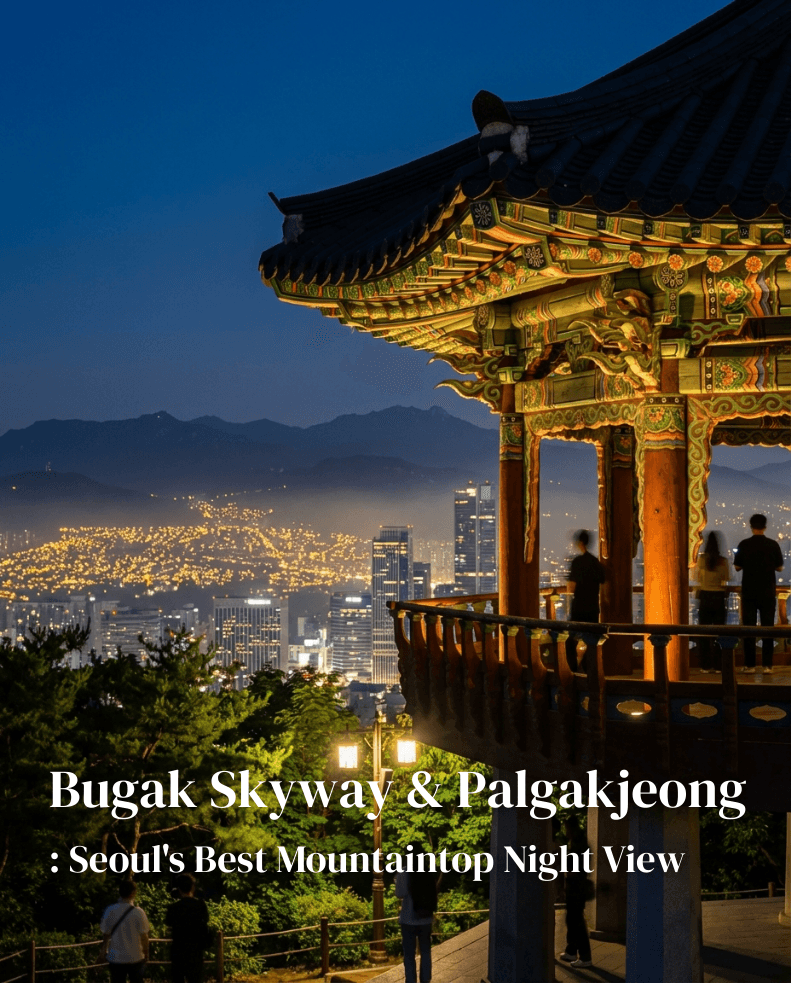
At 342 meters above sea level, Palgakjeong Pavilion sits at the highest point of Bugak Skyway—a winding mountain road that cuts through the forested northern edge of Seoul. The city spreads out below in an unbroken grid of lights, with Namsan Tower glowing in the distance and the downtown skyline filling the horizon. No observation deck fee, no elevator queue. Just a short drive and a panoramic view that rivals any paid observatory in the city.
This guide covers the best times to visit, how to get there without a car, and what to expect at the viewpoint itself.

At a Glance
| Address | 267, Bugaksan-ro, Jongno-gu, Seoul (서울 종로구 북악산로 267) |
| Hours | Mar-Oct: 05:00-21:00 / Nov-Feb: 06:00-18:00 |
| Admission | Free |
| Time Needed | 30 min - 1 hour |
| Best Time | 30 min before sunset through blue hour |
Why Visit Palgakjeong
Most Seoul viewpoints come with a price tag. N Seoul Tower charges ₩21,000 for observatory access. Lotte World Tower's Seoul Sky runs ₩29,000. Palgakjeong costs nothing—and the view competes directly with both.
The location matters too. Positioned on the northern mountain ridge, Palgakjeong looks south across the entire urban core. The Blue House (former presidential residence), Gyeongbokgung Palace grounds, Jongno's office towers, and Namsan all fall within the same sightline. On clear evenings, the distant peaks of Bukhansan frame the western edge of the panorama.
For photographers, the pavilion itself adds a compositional element that pure glass observatories lack. The traditional Korean architecture—painted wooden beams, curved roof tiles—creates foreground interest against the modern cityscape behind it.

The Drive: Bugak Skyway
Getting to Palgakjeong means driving Bugak Skyway (Bugaksanro)—an 11km mountain road that ranks among Seoul's most scenic urban routes. The road loops around Bugaksan and Inwangsan mountains, climbing through dense forest before opening up to city views at several points along the way.

The route attracts local drivers year-round, but each season shifts the character. Spring brings cherry blossoms along certain stretches. Summer evenings draw crowds escaping the heat. Autumn colors peak in late October. Winter snowfall—when roads remain open—creates the most dramatic contrast between white forest and dark asphalt.
Key stops along the route:
- Malbawi Rest Area: Midpoint parking with basic facilities
- Palgakjeong Parking Lot: Main viewpoint access, ~20 spaces
- Bugaksan Dulle-gil Trailhead: Connects to hiking paths
The road closes during severe weather and occasionally for security reasons (proximity to the former Blue House area). Check conditions before driving out, especially in winter.
What You'll See
The main draw is the 180-degree southern view. Standing at the pavilion railing or stepping inside the octagonal structure, the layout of Seoul becomes readable in a way ground-level exploration never allows.

Landmarks visible from Palgakjeong:
- Namsan Tower (illuminated at night)
- Gyeongbokgung Palace grounds
- Jongno and Gwanghwamun district
- Blue House complex (Cheong Wa Dae)
- Bukhansan peaks (western horizon)
The view transforms as daylight fades. Sunset paints the sky behind the western mountains. Blue hour deepens the contrast between warm city lights and cool sky tones. Full darkness turns Seoul into an abstract pattern of illumination—towers, streets, and neighborhoods all reduced to points and lines of light.
Best photo timing:
- Golden hour: 30 minutes before sunset for warm tones
- Blue hour: 20-40 minutes after sunset for balanced light
- Full night: After 8 PM for maximum city glow (summer) / after 6 PM (winter)
Getting There
By Car (Recommended) The most practical option. From Gyeongbokgung, head north on Samcheong-ro, continue past the Blue House area, and follow signs for Bugaksanro. The drive takes about 15-20 minutes depending on traffic. Parking at Palgakjeong is free but limited to roughly 20 spots—arrive before sunset on weekends to secure a space.
By Taxi From Gyeongbokgung Station: approximately ₩8,000-12,000 one way. Show the driver: "팔각정 전망대" (Palgakjeong Jeonmangdae). Return taxis can be difficult to find at the viewpoint—consider asking your driver to wait or use a taxi app for pickup.
By Bus Bus 143 runs along Bugak Skyway with a stop near Palgakjeong. Departures are infrequent (roughly every 30-40 minutes), and the last bus down leaves early evening. Check schedules carefully if relying on public transit.
By Rental Car International licenses are accepted for short-term rentals. Several agencies operate near Seoul Station and Hongdae. Rates start around ₩50,000-70,000 per day for compact vehicles.
Practical Tips
Timing matters more than weather. Clear skies help, but even slightly hazy evenings produce good city glow shots. Arrive 30-45 minutes before sunset to secure parking and watch the transition from day to night.
Dress warmer than expected. Mountain elevation drops temperatures 3-5°C compared to central Seoul. Wind exposure at the viewpoint amplifies the chill. Layers help, especially in spring and autumn when daytime warmth fades quickly after sunset.
Bring a tripod if you shoot photos. Low-light conditions at blue hour and beyond require longer exposures for sharp results. The pavilion railing works as a stabilizer in a pinch, but dedicated support improves image quality.
Weekday evenings draw fewer visitors. Weekend sunsets pack the small parking area. Tuesday through Thursday offers the most relaxed atmosphere and easiest access.
Combine with nearby spots. Samcheong-dong cafes sit 10 minutes downhill. Gyeongbokgung's evening hours (seasonal) allow a palace-then-viewpoint sequence. Inwangsan's fortress wall hike connects for more active itineraries.
Check road closure status. Bugak Skyway occasionally closes for weather or security. The Seoul Metropolitan Government posts updates, or call the Jongno-gu district office.
Is It Worth It?
For ₩0 admission, Palgakjeong delivers one of Seoul's strongest viewpoint experiences. The combination of traditional pavilion architecture, unobstructed sightlines, and free access makes it hard to argue against—especially for photographers or anyone wanting a break from Seoul's commercial observation decks.
Go if: You have access to a car or taxi, you enjoy sunset/night photography, you want a quieter alternative to tower observatories.
Skip if: You're relying solely on public transit with tight schedules, you prefer indoor heated viewing areas in winter.
The drive alone justifies the trip for many visitors. The view at the top confirms why locals keep returning.
📌 Quick Reference
- Address: 267, Bugaksan-ro, Jongno-gu, Seoul
- Hours: Mar-Oct 05:00-21:00 / Nov-Feb 06:00-18:00
- Admission: Free
- Parking: Free, ~20 spaces (arrives early on weekends)
- Best time: 30 min before sunset through blue hour
- Taxi phrase: 팔각정 전망대 (Palgakjeong Jeonmangdae)